82,478 Rows and a Google Drive Folder: How One C2 Server Pulled Data From Mexican Organizations
There’s no custom implant or polished framework in this story. The operator behind this C2 environment used a 30-line Python HTTP server, a few XML files, an SSH tunnel and a separate dump script for each target. All of the stolen data went to a Google Drive remote named leviathan-drive.
In late October 2026, that setup was pointed at five organizations in Mexico: two telecom providers, an insurance platform, a state government and a public university. In our C2 Environment and Targeted Data Extraction report, ThreatMon’s threat intelligence team reconstructed how it worked from the server’s own scripts and logs.
Key Findings
The environment held separate, purpose-built extraction scripts for five Mexican targets: two telecom providers, one insurance provider, one government entity and one university. Victim names are anonymized in the report.
The logs record completed extraction and cloud sync for three of them: 82,478 SIM-related rows from Telecom Provider A, 306 invoice records from Telecom Provider B and 554 records from the insurance platform.
Access appears to start with malicious XML payloads run through Java’s ProcessBuilder, followed by a reverse SSH tunnel that exposes internal Oracle databases (TCP/1521).
Data left in compressed .jsonl.gz files through rclone to Google Drive, and local copies were deleted after each upload.
The server also stored WebLogic configuration, encrypted DB credentials and an ED25519 SSH private key. These remain a risk if they’re still valid.
Initial access, the operator’s identity and the full volume of exfiltrated data were not established.
How the Operation Fits Together
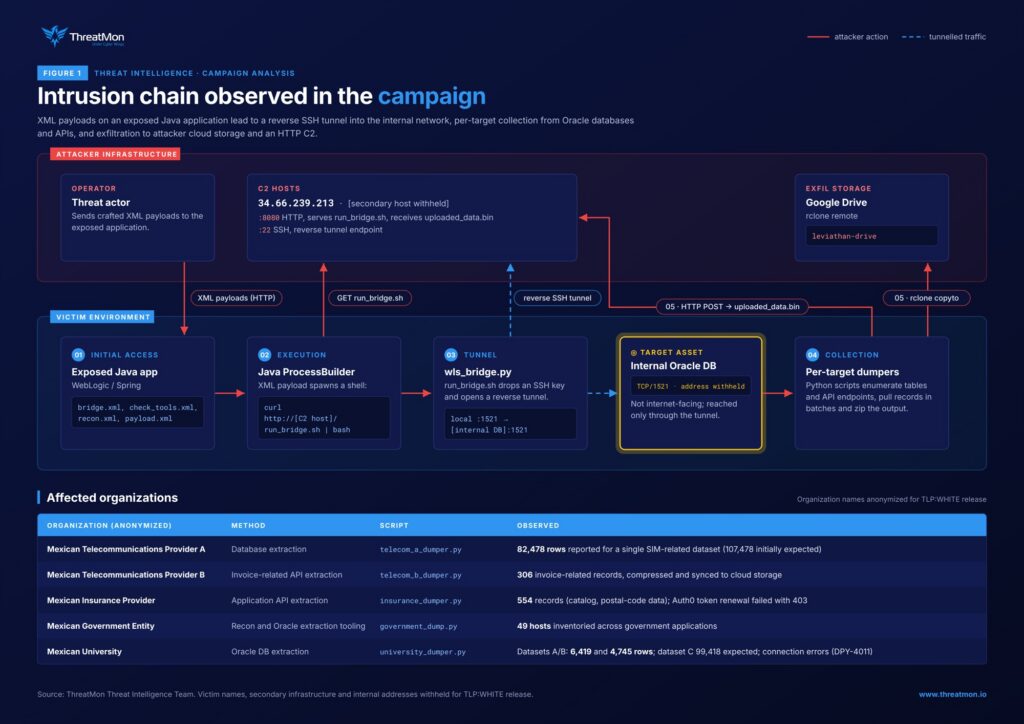
The tooling isn’t one C2 framework. It’s a kit of small tools, one per stage. The report’s reconstruction of the chain looks like this:
Intrusion chain observed in the campaign
Execution. Four XML files carry Java and Spring constructs that run shell commands. bridge.xml uses ProcessBuilder to download run_bridge.sh from 34.66.239.213 and run it. recon.xml and check_tools.xml map the host. payload.xml tries to bundle WebLogic config and credential files. These files point to an exposed Java/WebLogic application as the entry point, but we couldn’t tie them to a specific CVE.
Tunneling.run_bridge.sh downloads an SSH key and wls_bridge.py. The bridge then reads its endpoints from remote JSON config and opens a reverse tunnel that forwards port 1521. That way, an Oracle database with no internet exposure can be queried from outside without ever opening a public listener.
wls_bridge.py with fallback SSH targets (redacted)
Collection. The “C2 server” is mostly a drop box. c2_server.py listens on port 8080 and saves POST bodies to different files depending on the URL path: wls_secrets.tar.gz, SerializedSystemIni.dat (the WebLogic file needed to decrypt stored passwords) or recon_output.txt.
c2_server.py saving incoming POST data by path
What Was Taken, and What We Can't Confirm
Between 17 and 27 October 2026, researchers observed a single ARTEX controller directing activity against more than 200 organizations in at least 14 countries. Targets included foreign ministries, other government bodies, telecommunications providers and organizations in the pharmaceutical, semiconductor, defense and financial sectors. Investigators confirmed post-exploitation at nine organizations and reported credential scanning or password spraying against at least 12 more. These numbers describe different levels of observed activity and should not be treated as a count of 200 breaches.
The recovered engagements illustrate how agents moved between environments without following one fixed playbook:
Web weakness to cloud privilege. At a U.S. pharmaceutical organization, an unsigned SAML assertion and an XML external entity (XXE) flaw were chained to reach a cloud instance metadata service. The resulting role could issue administrative commands to thousands of instances.
Container access to domain identity. At a second pharmaceutical organization, agents deployed web shells, obtained root access through an exposed orchestration service, retrieved LAPS passwords and abused resource-based constrained delegation to impersonate a privileged account.
Old keys, current access. Against a Greek government entity, the operator provided a mail-server directory export dating to 2022. Authentication keys from that export were used to forge an administrative token, read mailboxes and support further access through recovered VPN material.
BLOODALCHEMY deployment. In government intrusions, the actor used a legitimate GameHook executable renamed svchost.exe, alongside graphics-hook-filter64.dll and an encrypted payload file, graphics-hook_config.bin. The recognizable executable name did not make the activity benign.
The ThreatMon perspective: these intrusion paths make external exposure a practical investigation priority. ThreatMon Attack Surface Intelligence helps teams identify and prioritize internet-facing assets and potentially exposed management interfaces; ThreatMon Dark Web Intelligence can add context when organizational credentials appear in monitored sources. Neither finding proves intrusion on its own, but each can direct defenders toward the affected service and responsible owner.
The Infrastructure Behind It
The host is named rclone-leviathan-worker. Its journal covers 20 to 29 October 2026 across four boot sessions. NetBird status showed an active WireGuard P2P tunnel linking two public IPs that also appear in the C2 tooling, with 214 MiB sent and 44 MiB received at the time of capture. That confirms the infrastructure is connected. It doesn’t show what crossed the tunnel.
If you run WebLogic or other Java middleware in front of Oracle, watch for Java processes that spawn curl | bash or sh children, and for outbound SSH from application servers. Neither should be normal. On the network side, rclone traffic to Google Drive from a database or app server is a strong sign that data is leaving. If SerializedSystemIni.dat or your JDBC config could have been exposed, rotate the database credentials it protects.
Conclusion
This is the opposite of the CCDS framework we published two days earlier. CCDS had plenty of capability and no victims. This operator built almost nothing reusable, yet still walked away with real records from real organizations. They wrote one script per target, tunneled into each database and synced to Drive. That kind of targeted, low-tooling theft is hard to catch with signatures alone.
It’s also why visibility after the fact matters. Data pulled this way often ends up in underground markets and leak channels, sometimes months later. ThreatMon Dark Web Intelligence and Data Leak & PII Detection monitor those sources for an organization’s data, credentials and customer records. Attack Surface Intelligence flags exposed Java and WebLogic services before someone else finds them. For telecom and government teams in particular, those two gaps are where this operation got in and where its data will eventually turn up.
If you think your environment matches any of the indicators above, our Response & Recovery team can help. You can also talk to us about ongoing monitoring.