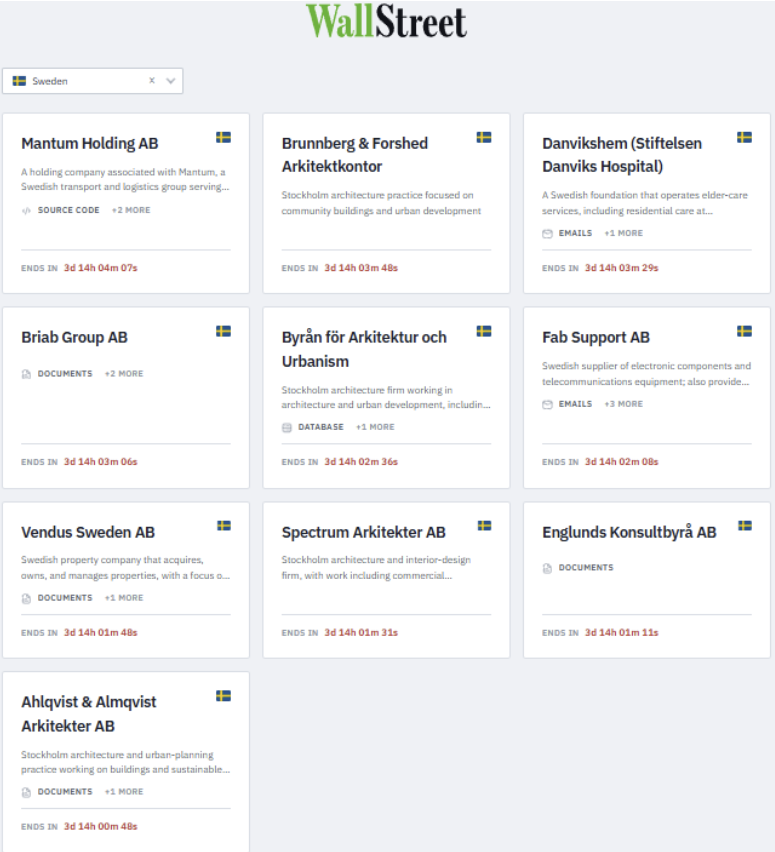
During routine dark web monitoring activities, ThreatMon analysts identified a notable concentration of Swedish organizations among the victims recently listed by the Wallstreet ransomware group. On October 13, 2026, the group published 10 Swedish organizations on its dark web leak site, accounting for approximately 25.6% of its 39 publicly identified victims since emerging in June 2026.
The affected organizations span multiple industries, with a particularly notable concentration in architecture and urban development. Four of the listed organizations operate within the architectural services sector, while several maintain a presence in Stockholm. This overlap raises questions about potential shared business relationships, third-party dependencies, or infrastructure that could have contributed to the alleged incidents.
Wallstreet’s disclosures include claims involving internal documents, databases, credentials, emails, financial information, personal data, and source code. Although these categories suggest potentially significant exposure, the authenticity and extent of the allegedly compromised information have not been independently verified.
ThreatMon assesses that the Swedish victim cluster represents a distinctive development in Wallstreet’s observed activity. However, the available evidence does not establish whether the underlying incidents are connected through a common intrusion method or whether the group deliberately published unrelated victim claims together. The findings highlight the importance of correlating ransomware disclosures to identify emerging patterns while distinguishing confirmed observations from unverified threat actor claims.
On October 13, 2026, during routine dark web monitoring activities, ThreatMon analysts identified a batch of 11 new victim listings on the Wallstreet ransomware group’s dark web leak site, including 10 organizations based in Sweden and one in Germany.
The newly listed Swedish organizations operate across several industries, including architecture, urban planning, real estate, logistics, and healthcare. Notably, multiple organizations are based in Stockholm and operate in closely related business sectors, raising questions about whether the listings represent independent incidents or potentially connected compromises.
Further examination of the leak site revealed that the newly published listings shared nearly identical countdown deadlines. Several entries also contained claims involving confidential documents, databases, employee credentials, financial records, and personal information. However, the group has not publicly disclosed sufficient technical evidence to establish how the organizations were allegedly compromised or whether the incidents share a common initial access vector.
The unusual concentration of Swedish organizations, combined with the coordinated publication timing, warrants further investigation into Wallstreet’s recent activities and potential targeting patterns.
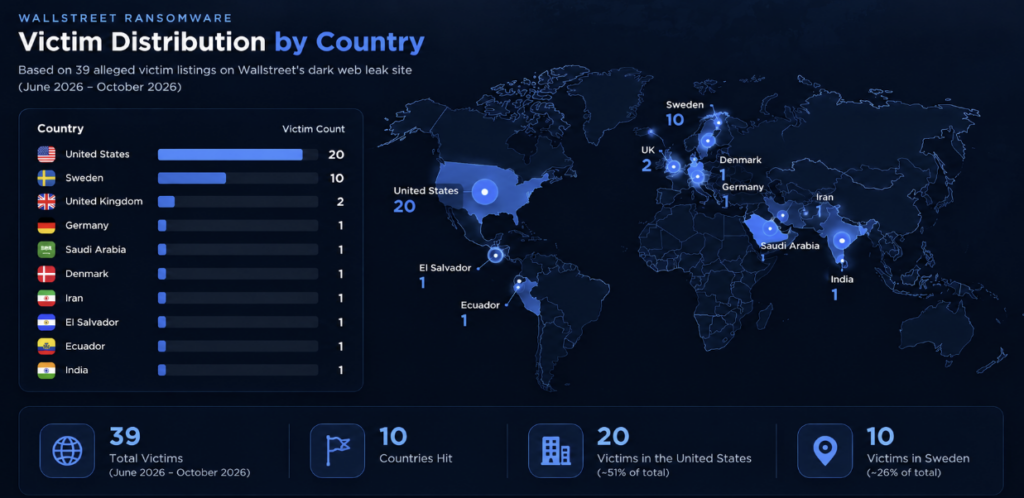
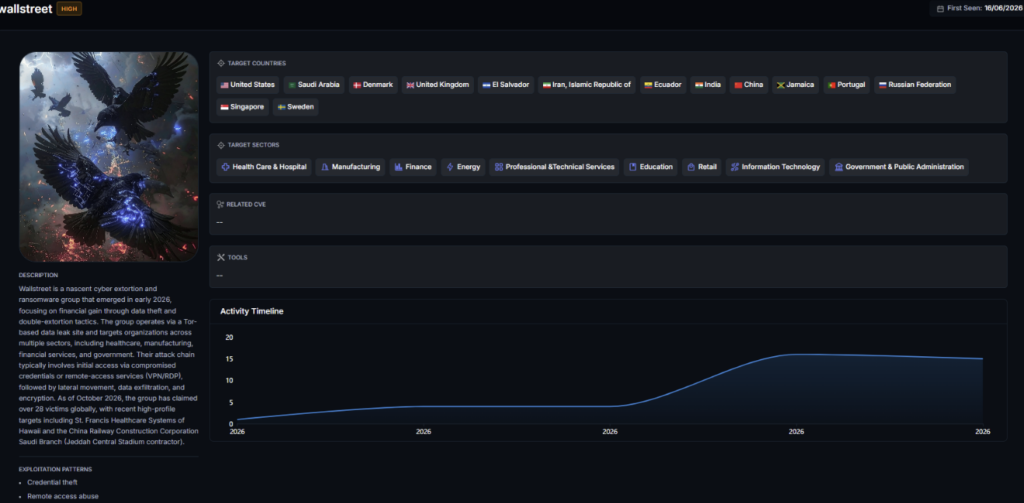
Wallstreet is a relatively new ransomware group whose activities were first publicly observed in June 2026. The group’s earliest recorded victim listing was discovered on June 26, 2026, with the associated attack date estimated as June 16. As of October 13, 2026, Wallstreet had listed 39 alleged victims across 10 countries on its dark web leak site.
An examination of the group’s victim history indicates a strong concentration in the United States, which accounts for 20 of the 39 listings, followed by Sweden with 10. Other identified countries include the United Kingdom, Germany, Saudi Arabia, Denmark, Iran, El Salvador, Ecuador, and India.
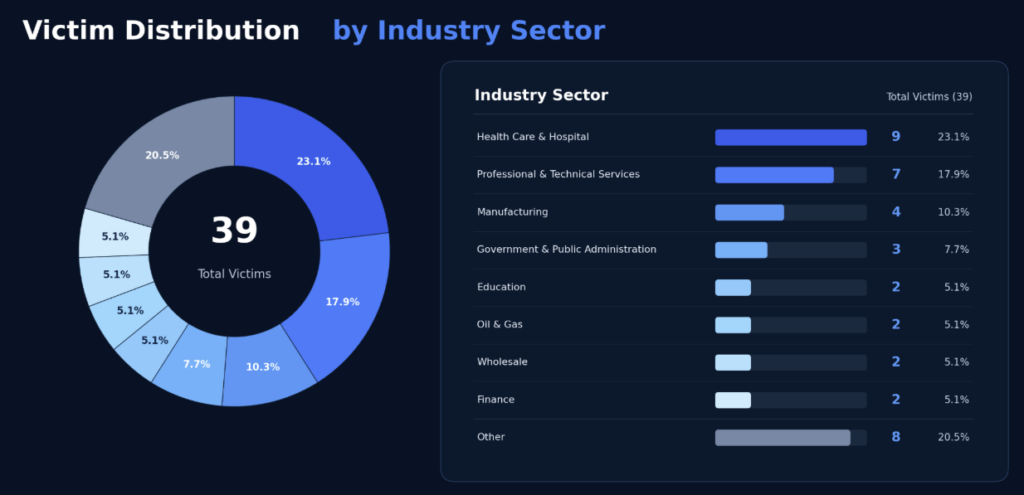
Wallstreet’s published victim listings are most frequently associated with healthcare (8 listings), manufacturing (7), and professional services (6). Education-related organizations also appear among the listings, indicating that the group’s publicly claimed victims span multiple industries rather than being concentrated exclusively within a single sector.
The group’s leak site follows a countdown-based disclosure model, with victim entries displaying deadlines and categories of allegedly compromised information. These categories include internal documents, databases, credentials, financial records, and personal data. Such disclosures appear intended to increase pressure on affected organizations by threatening the public release of sensitive information.
Although Wallstreet has maintained a visible presence since June, the group’s technical capabilities, ransomware payload, initial access methods, and potential connections to other cybercriminal operations remain insufficiently documented. Consequently, its current operational profile is primarily based on observed leak-site activity rather than independently verified intrusion evidence.
An examination of the October 13 disclosures identified 10 Swedish organizations across multiple industries, with a notable concentration in architecture and urban development. Wallstreet assigned different categories of allegedly compromised information to several victim listings, including internal documents, databases, credentials, emails, financial information, and personal data. The following table summarizes the information categories claimed by Wallstreet for each organization.
Organization | Allegedly compromised data |
Ahlqvist & Almqvist Arkitekter AB | Documents, Databases |
Englunds Konsultbyrå AB | Documents |
Spectrum Arkitekter AB | Not specified |
Vendus Sweden AB | Documents, Emails |
Fab Support AB | Emails, Credentials, Media, Personal Data |
Byrån för Arkitektur och Urbanism | Databases, Documents |
Briab Group AB | Documents, Databases, Credentials |
Danvikshem (Stiftelsen Danviks Hospital) | Emails, Financial Data |
Brunnberg & Forshed Arkitektkontor | Not specified |
Mantum Holding AB | Source Code, Credentials, Personal Data |
Wallstreet’s recent activity demonstrates why ransomware victim disclosures should be examined collectively rather than as isolated incidents. While individual leak-site announcements provide limited visibility into an alleged compromise, their timing, geographic distribution, and industry characteristics can reveal patterns that may otherwise remain unnoticed.
The concentration of Swedish architectural and related organizations raises several possibilities. Shared technology providers, overlapping business relationships, or common external dependencies could potentially explain similarities between the affected organizations. However, an alternative explanation is that Wallstreet accumulated access to unrelated victims over time and published their listings together as part of its disclosure strategy.
The nearly identical countdown deadlines across the Swedish listings support the assessment that the announcements were published in a coordinated manner. Nevertheless, synchronized publication does not necessarily indicate simultaneous intrusions or a shared initial access vector.
Another important consideration is the nature of the allegedly compromised information. Claims involving credentials, personal data, and source code may indicate risks extending beyond the immediate exposure of confidential documents. However, without independently verified samples or technical evidence, the authenticity and potential impact of these claims cannot be established.
ThreatMon assesses that the Swedish victim cluster represents a notable ransomware disclosure pattern rather than confirmed evidence of a coordinated intrusion campaign. To investigate potential connections between the affected organizations, analysts should examine shared IT and cloud service providers, overlapping infrastructure such as hosting environments and VPN gateways, common initial access indicators, and similarities in authentication logs, suspicious IP addresses, or attacker TTPs. Correlating these findings with newly emerging technical indicators would help determine whether the incidents are operationally connected or represent unrelated compromises published together.
Ransomware leak sites can provide early indications of emerging threat activity, but individual victim listings rarely reveal the full scope of an incident. Continuous ransomware leak site monitoring and dark web intelligence collection allow security teams to observe changes in victim distribution, identify recurring industry sectors, and detect unusual publication patterns that warrant further investigation.
ThreatMon’s ransomware monitoring and external threat intelligence capabilities help analysts track newly published victim claims, examine threat actor activity, and correlate relevant indicators across multiple sources.
In the Wallstreet case, tracking the group’s listings over time helped identify an unusual concentration of Swedish organizations, including several firms operating in architecture and related sectors. This pattern provides a starting point for further investigation, but it does not establish that the organizations share a service provider, infrastructure, or intrusion path.
By combining ransomware threat intelligence with ongoing monitoring and independent technical investigation, security teams can better prioritize emerging threats, assess potential exposure, and distinguish meaningful indicators from unverified threat actor claims.
The Wallstreet case demonstrates that ransomware leak-site monitoring is most valuable when individual disclosures are analyzed as part of a broader activity pattern rather than in isolation.
For security teams, the key priority is to monitor sudden concentrations of victim listings, recurring geographic or industry patterns, changes in disclosure frequency, and the appearance of sensitive data categories such as credentials and source code. Particular attention should also be given to newly emerging technical indicators and evidence of shared third-party dependencies that could help establish connections between otherwise separate incidents.
Ultimately, these signals should guide threat prioritization and further investigation, while independent technical evidence remains essential for validating suspected relationships and assessing actual exposure.

More posts



Share this article
Found it interesting? Don’t hesitate to share it to wow your friends or colleagues
Subscribe to our blog newsletter to follow the latest posts