760,000 Leaked Logins and Five Spy Campaigns: Inside Pakistan's Worst Cyber Year Yet
Pakistan’s government portals, universities, and hospitals spent 2026 under near-constant pressure from state-backed spies on one side and profit-driven criminals on the other. ThreatMon tracked all of it for its Pakistan Cyber Threat Landscape Report 2026, and the numbers underneath the headlines are worth a closer look.
Key Findings
State-linked espionage from China- and India-aligned groups targeted Pakistani law enforcement, defense, and government networks between January and April 2026.
Seven ransomware incidents were confirmed, with healthcare hit hardest (three cases).
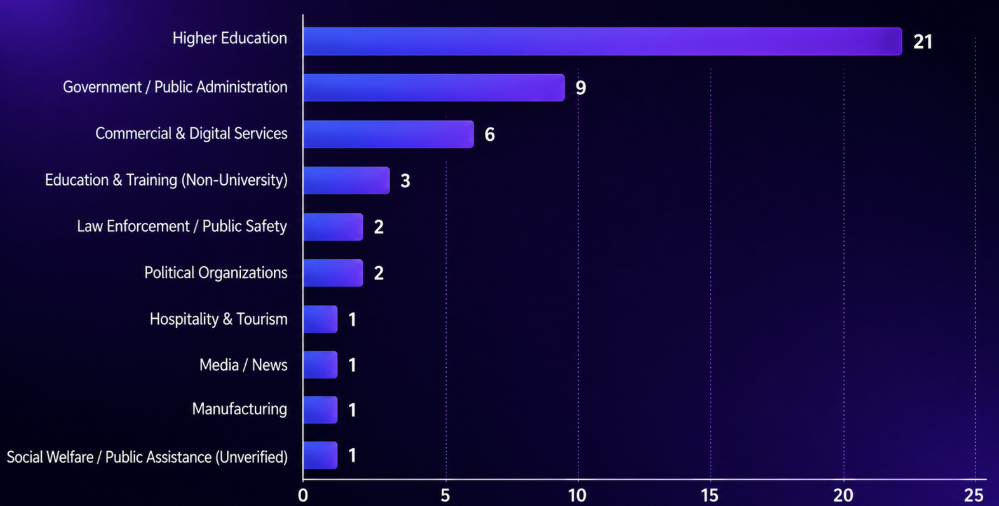
47 web defacements were recorded, 44.7% of them against higher-education sites.
275 dark web incidents were tracked in total mostly data breaches (131) and defacements (104), followed by DDoS (26) and initial-access sales (14).
Government was the single most targeted sector, with 77 recorded dark web incidents more than double any other industry.
Roughly 760,000 Pakistan-linked URLs turned up in infostealer malware logs, 57.6% of them tied to .gov.pk domains.
What Happened, Exactly?
Five distinct pressure points converged on Pakistan this year: espionage campaigns against law enforcement and defense networks, a wave of ransomware against healthcare and finance, dozens of defaced government and university websites, a satellite broadcast hijacking during prime-time news, and a steady bleed of credentials through infostealer malware.
None of it happened in a vacuum. A police complaint portal got turned into a malware host. Leaked university logins fed initial-access brokers on criminal forums. The common thread: attackers went after whichever surface was weakest that week an unpatched server, a phishing document, an infected laptop not necessarily the most “important” one.
Sector Distribution of Web Defacement Incidents
Who's Behind It and Who's Getting Hit?
Two very different types of actors were operating side by side.
The Spies
Chinese state-linked operators and India-aligned groups both ran sustained campaigns against Pakistani law enforcement, with Balochistan Police as a recurring target for both sides China reportedly after intelligence on threats to Chinese nationals and CPEC infrastructure, India after insight into Pakistan’s security posture in the region. SloppyLemming (India-aligned) expanded into telecom and nuclear-adjacent targets using a custom backdoor called BurrowShell. Mustang Panda kept updating its CoolClient toolset against Asian government networks. A cluster tracked as SHADOW-EARTH-053 skipped the need for a zero-day entirely, walking into unpatched Microsoft Exchange servers through the years-old ProxyLogon flaw.
The Criminals
Ransomware operators The Gentlemen, Qilin, DragonForce, NightSpire, APT73, WorldLeaks claimed victims across healthcare, insurance, education, and retail. On underground forums, two aliases, Nicotine and Umbra Community, topped the activity charts with 20 recorded incidents each, ahead of Keymous Plus, Flipperone, and Indian Cyber Mafia.
Who got hit hardest: government agencies, by a wide margin, followed by education (driven partly by a cluster of university defacements tied to Dawood University of Engineering and Technology), then healthcare, telecom, e-commerce, and aviation.
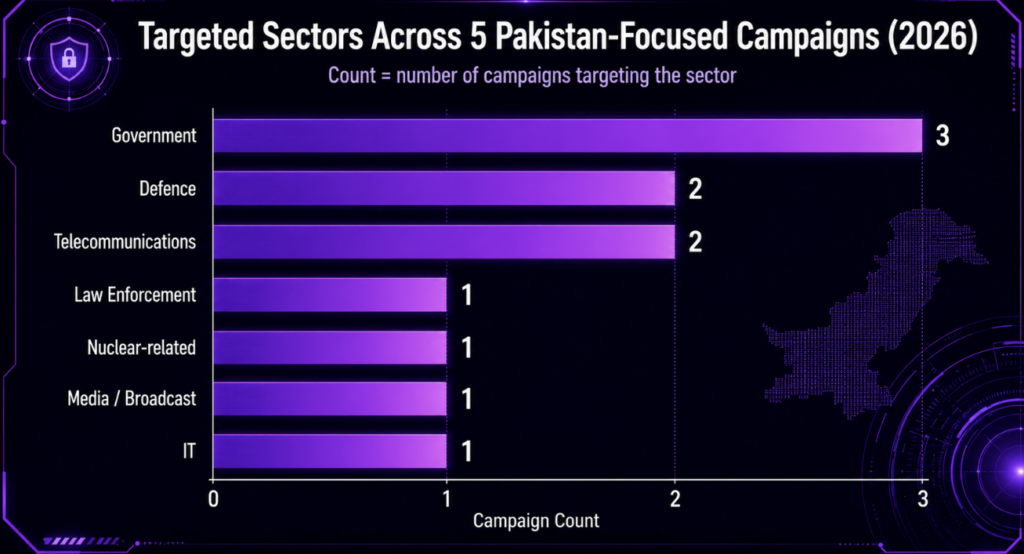
Targeted Sectors Across 5 Pakistan-Focused Campaigns (2026)
When Did This All Happen?
There wasn’t a quiet month. Law enforcement espionage campaigns ran January through April. Keymous Plus hit three government websites Foreign Affairs, Defence, and Punjab on the same day, March 17. That same month, a hijacked PAKSAT satellite feed knocked Geo News off air during its evening bulletin. April brought both the SHADOW-EARTH-053 disclosure and a ransomware hit on Beaconhouse School System. By June, a dataset claiming over 30 million Pakistan International Airlines flight records was listed for sale; by July, EFU Life Assurance had joined the ransomware victim list.
Why Pakistan, Why Now?
Two forces are pulling in the same direction. Geopolitically, Pakistan sits at the intersection of Chinese infrastructure investment (CPEC) and long-running regional tension with India which explains why both countries’ state-aligned actors keep showing up in the same police networks, just with different objectives. Economically, Pakistani organizations hold data that’s cheap to steal and easy to sell: a dataset of nearly two million people’s phone numbers and national ID numbers, pulled from a platform called WEBDOC, was listed for just $600. When the payout is that low-effort, the volume of attempts goes up.
How Are They Getting In?
Strip away the branding and most campaigns reused a small, familiar toolkit:
DLL sideloading a legitimate signed executable loads a malicious DLL sitting next to it. Seen across CoolClient, ShadowPad, and BurrowShell alike.
Unpatched, years-old vulnerabilities SHADOW-EARTH-053 didn’t need anything new; ProxyLogon on unpatched Exchange servers did the job.
Weaponized trusted infrastructure the Balochistan Police complaint portal, meant for citizens checking case status, was quietly turned into a malware drop point.
Decoy documents a fake “repatriation plan” file, built to look credible to police staff, delivered Remcos RAT.
Infostealers Lumma Stealer, Meta Stealer, Vidar, and StealC harvested browser sessions from infected machines, which is how so many .gov.pk and .edu.pk logins ended up in criminal datasets without those organizations being breached directly.
A sample of the kind of indicator ThreatMon tracked through this period (defanged for safety):
The infostealer numbers deserve a second look, because they’re easy to misread. Out of ~760,000 Pakistan-linked URLs in stealer logs, .gov.pk accounted for 57.6% and .edu.pk another 27.9% led by fbr.gov.pk (tax authority), punjab.gov.pk, and nadra.gov.pk (national ID database). That doesn’t mean those systems were hacked. It means an employee, student, or citizen logged in from a device that was already compromised, and their session got scooped up along with everything else on it. That’s a much larger, quieter attack surface than any single breach headline, and it’s the one most often missed by traditional security monitoring.
ThreatMon's Take
This is the piece ThreatMon’s analysts kept coming back to while building the report: almost none of these incidents required a novel exploit. ProxyLogon is years old. DLL sideloading is a known technique. Infostealer malware is commodity crimeware sold on forums for a few hundred dollars. The sophistication here isn’t in the tools it’s in the patience and the targeting logic, especially on the espionage side, where operators clearly picked systems (complaint portals, biometric databases, personnel records) that pay off over years, not days.
That’s also why continuous dark web and infostealer monitoring matters more than a one-time audit. A leaked NADRA credential or a .gov.pk session cookie sitting in a stealer log today is exactly the kind of thing that turns into an initial-access listing next month, and a ransomware incident the month after that. ThreatMon’s own tracking of underground forums and C2 infrastructure is what surfaced the WEBDOC, PIA, and DGMP listings well before they became public news stories the same visibility gap the report’s roadmap section is built to close, through Zero Trust access controls, mandatory MFA on government and VPN systems, faster patching for internet-facing services, and ongoing credential-exposure monitoring.
From exposed credentials to dark web activity and threat actor infrastructure, nationwide cyber risk requires continuous visibility. Explore ThreatMon National Cyber Defence.