
On August 28, 2026, Rhysida claimed to have targeted the Berlin State Administration in Germany. An analysis of the ransomware group’s leak site revealed that the attackers systematically scanned and categorized approximately 1.44 million files and claimed to have seized a massive 5.79 terabytes of data.
Following the administration’s refusal to meet ransom demands, the threat actors escalated their pressure tactics by putting the stolen archives up for auction. Security analysts and investigators emphasize that while the scale of the exfiltrated database is documented by the group’s leaks, the full scope and immediate operational impacts remain subject to ongoing evaluation.
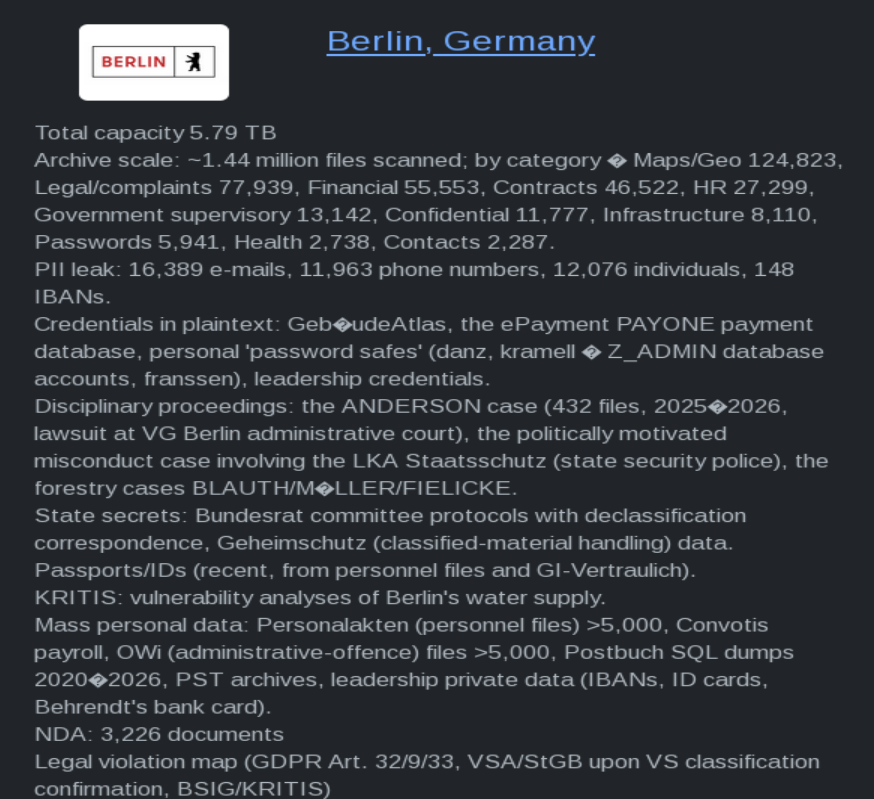
Rhysida claims to have stolen 5.79 TB of data, consisting of approximately 1.44 million file
The cyber attack directly targeted the administrative infrastructure of the Berlin state government and related public sector entities. The alleged breach encompasses sensitive departmental and regional divisions:
The 5.79 TB data dump reportedly contains a vast array of high-value administrative, financial, and personal records. The exposure profile elevates significant compliance and security risks:
This diverse repository presents multi-vector exploitation risks ranging from identity fraud to direct threats against regional operational security.
As of reporting, the precise initial access vector utilized by the Rhysida ransomware operators remains unverified by public forensic authorities. Common threat mechanisms typically associated with enterprise-scale ransomware deployment include compromised credentials via infostealer malware, phishing campaigns, or unpatched perimeter vulnerabilities.
Organizations must treat these specific entry vectors as unverified hypotheses until formal forensic investigations are fully concluded and published by incident response teams.
A structured breakdown helps security leaders differentiate between verified data listings from threat actor portals and official confirmations:
Institution | Actor Claim | Evidence (Credential Log / Leak Portal) | Official Confirmation / Response |
Berlin State Administration | 5.79 TB exfiltrated data, 1.44M files classified and auctioned | Dark web leak site samples including PII, credentials, and internal protocols | Ransom rejected; ongoing assessment of the breach scope |
The Rhysida attack on the Berlin State Administration transcends a standard ransomware encryption event by directly compromising critical infrastructure (KRITIS) oversight and government secrets. The exposure of plaintext management credentials, water supply vulnerability analysis, and high-tier financial data creates severe secondary risks:
The timing adds another layer of sensitivity. Any confirmed exposure involving citizen data or critical infrastructure documentation would increase the potential impact of the incident beyond a conventional ransomware case. In a critical city like Berlin, the leak of both citizens’ personal data (GDPR violations) and critical infrastructure and water management data just weeks before the elections makes it abundantly clear that public institutions must urgently review their network security, internal network segmentation, and crisis management processes. As extensively reported by mainstream outlets such as RBB24, the decision not to pay the ransom and instead put the data up for auction on the eve of the election lays bare the pressure tactics threat actors employ against public institutions.
Incidents like the alleged Berlin State Administration breach highlight the importance of detecting external threat signals before they develop into broader security incidents. For public-sector organizations, this requires visibility beyond the internal network and traditional security controls.
ThreatMon helps security teams strengthen this visibility by continuously monitoring external attack surfaces, underground sources, and threat actor activity for signals that may indicate emerging exposure.
For public sector organizations managing sensitive citizen data and critical infrastructure, gaining early visibility into these external signals is critical for minimizing risks, preventing service disruptions, and ensuring public safety.
Public sector teams need to connect ransomware activity, leaked credentials, exposed assets, and threat actor activity to understand the risks facing their organizations. Looking at these signals separately can make it difficult to see the bigger picture and identify threats early.
This is where ThreatMon’s external threat intelligence capabilities come into play. ThreatMon combines dark web monitoring with data theft intelligence to help organizations track compromised credentials and leaked corporate assets before they are used in ransomware campaigns. It continuously monitors threat actors’ forums, auction sites, and underground channels, giving security teams visibility into relevant activity and helping them respond before threats escalate.
For public sector organizations, this intelligence can support the protection of critical infrastructure and public sector networks against evolving cyber threats. The ThreatMon National Cyber Defence module brings this intelligence together to help organizations identify relevant threats and take action to strengthen their security.
The alleged Rhysida attack on the Berlin State Administration shows why ransomware risk needs to be monitored before encryption begins. Public institutions may already be exposed through compromised credentials, exposed assets, infostealer logs, dark web activity, or signals linked to threat actors.
These signals do not always mean an attack is imminent, but they can provide important context about where an organization may be at risk. Monitoring them early gives security teams a better chance to identify weaknesses, investigate suspicious activity, and take action before a ransomware incident becomes a larger operational or public crisis.
For public sector organizations, ransomware prevention is not only about responding to an attack. It also means monitoring external signals that may reveal risk before it reaches the point of encryption, disruption, or data exposure.
The lesson from Berlin is not simply that public institutions are attractive ransomware targets. It is that the warning signs of ransomware risk often exist outside the perimeter before the incident becomes a public crisis.

More posts



Share this article
Found it interesting? Don’t hesitate to share it to wow your friends or colleagues
Subscribe to our blog newsletter to follow the latest posts