The promise of peer-to-peer (P2P) sharing is simple: an expensive game, a licensed application, even a pre-activated operating system, free and a few clicks away.
But there is a fundamental difference between downloading a TV episode and downloading a program. You think you’re watching a movie. In reality, you’re running a program. A video is opened by a media player and cannot do anything on its own. An installer, a game or a “crack” runs with your privileges the moment it is launched, and during installation it usually runs as administrator. Running a program from an unknown source means handing the keys to your computer to someone you have never met.
As of October 28, 2026, we recorded 8,408,577 peer observations across 35 categories in public P2P shares. This post focuses on the smallest but most dangerous part of that picture: the 70,391 peers in categories that contain executable files.
8.4M | 70,391 | 0.84% | 6 |
total peer observations | peers in executable categories | share of all observations | executable categories |
Malware has to be run to do anything. That is why attackers favor files that users already intend to run:
Media file (video, music, book) | Executable file (game, software, OS, app) | |
|---|---|---|
What does the user do? | Opens it and watches or reads | Installs and runs it |
What processes the file? | A media player or reader | The computer itself |
With what privileges? | The player’s limited privileges | The user’s privileges; usually administrator during installation |
How easy is it to add malicious code? | Hard; usually needs a fake file or an extra lure | Easy; code added to the installer runs alongside the program |
Does the user notice? | Gets suspicious if the video doesn’t play | Usually not, because the program keeps working |
The last row is the critical one. A game installer with malicious code added still installs the game. The user plays it and has no reason to think anything is wrong, while another program keeps running in the background.
Across all categories, executable files look like a small slice:
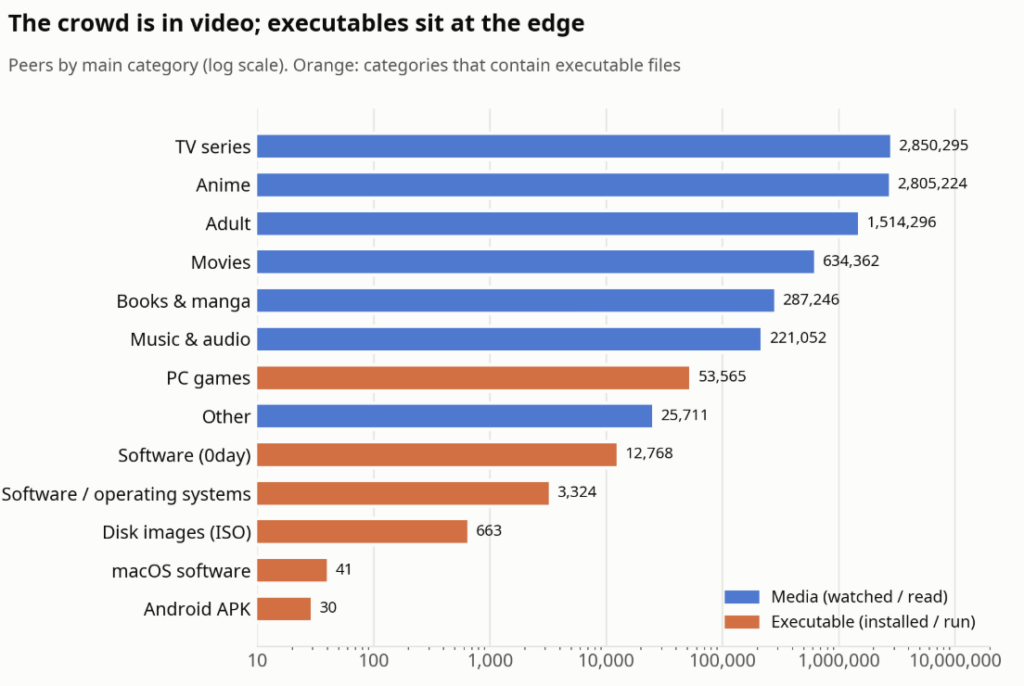
Figure 1: Peers by main category (log scale). Orange bars mark categories that contain executable files.
But 70,391 peer observations is not a small number. Because the same IP address can appear in more than one observation, this figure is not a count of unique devices; each observation records an instance of a program from an unknown source being downloaded or shared.
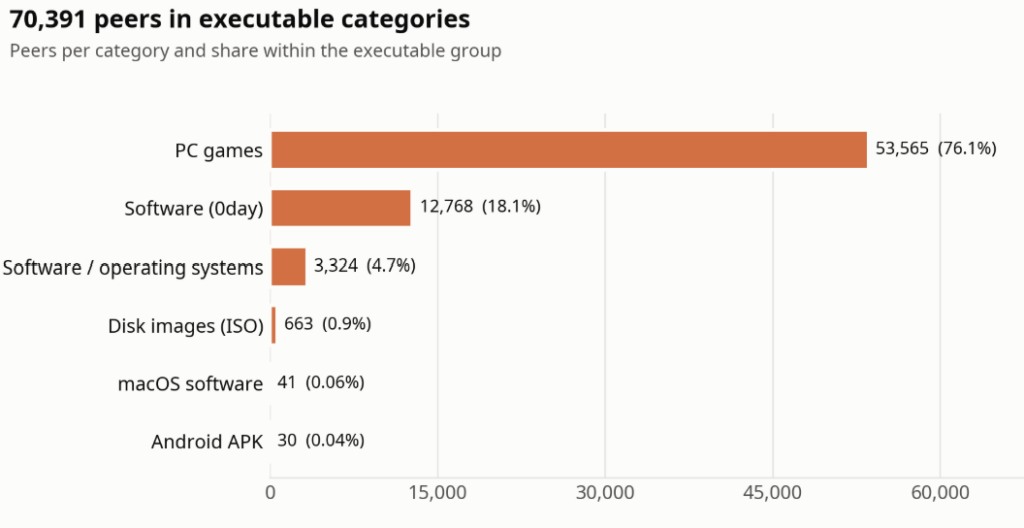
Figure 2: Peers in executable categories and their share within the group.
Category | Peers | Share of total | Typical size | Top countries | Most popular share |
|---|---|---|---|---|---|
PC games | 53,565 | 0.64% | 3.45 GB | US, China, Canada | Avatar: Frontiers of Pandora repack (87.1 GB) |
Software (0day) | 12,768 | 0.15% | 125.7 MB | US, India, Canada | Visual Studio Code offline installer (108.5 MB) |
Software / OS | 3,324 | 0.04% | 319.7 MB | US, Canada, UK | “TPM Bypassed & Pre-Activated” Windows 11 Pro (6.79 GB) |
Disk images (ISO) | 663 | 0.008% | 2.17 GB | US, Turkey, Iceland | Arch Linux install image (1.49 GB) |
macOS software | 41 | <0.001% | 3.06 GB | US, Canada, France | Microsoft Office for Mac + Crack (3.06 GB) |
Android APK | 30 | <0.001% | 54.3 MB | UK, US, Hong Kong | SnapTube “Premium Cracked APK” (54.3 MB) |
Total | 70,391 | 0.84% |
Note “0day” here does not mean a zero-day vulnerability. In file-sharing circles, “0day” is a category name for newly released software that is distributed quickly after release. |
PC games: the biggest crowd, the biggest installers
Three quarters of peers in executable categories are in games. A typical game share is 3.45 GB; the most popular one is 87 GB.
Most game shares are so-called “repacks”: compressed packages that ship with their own installer to unpack and write files to the system. For the user, this means running a package of tens of gigabytes, whose contents they cannot inspect, with administrator rights.
Three factors amplify the risk:
Software (0day): a “free” copy of free software
The most popular share in this category is Visual Studio Code, a code editor Microsoft already distributes for free. Users joining this share are downloading from an unknown source a program they could get from the official website safely and at no cost.
This shows that downloading software over P2P is not always about saving money. Sometimes it is habit, sometimes convenience. The outcome is the same: the user takes on all of the risk for none of the benefit.
This is the only executable category with India among its top downloading countries, and its most popular share is a developer tool. That matters: developer machines have access to source code, server access keys and cloud accounts, which makes them particularly valuable targets.
Operating systems: the layer beneath everything
This category is topped by a Windows 11 Pro installation image labeled “TPM Bypassed & Pre-Activated”. The label means two things:
Installing it means running the most fundamental layer of the computer, the operating system, from a copy prepared by an unknown party. A modified operating system can see every program running on it, every password entered and all network traffic. Activation tools are also routinely flagged as malicious by security software, so users get used to ignoring those warnings, which makes a real threat harder to notice.
Disk images: legitimate content, a source that still needs verifying
The most popular share in this category is an Arch Linux installation image. Arch Linux is free and open source, and P2P is one of the official distribution methods for many Linux distributions. Not every P2P share is pirated content.
Even legitimate content should not be used without verification, though. Official distributions publish signatures and checksums so users can confirm a download has not been altered. A disk image installed without that check could be a modified copy. Turkey ranks second among downloading countries in this category, so the advice applies directly to Turkish users too.
MacOS and Android: the “it won’t happen to me” fallacy
Observation counts in these two categories are very small (41 and 30 peers), so we treat them as examples rather than statistical trends. The examples are clear, though:
What happens when a cracked program or game installer is run is one of the best-known malware chains in threat intelligence:
If the device is a work computer, the last link in the chain is far more serious. Credentials for corporate email, VPN, cloud and SaaS accounts are among the most common initial access routes ransomware groups use to enter corporate networks. The real price of a free program is often paid by the user’s employer.
Finding | Status | ThreatMon Assessment |
|---|---|---|
70,391 peers in executable categories | Measured | 0.84% of the total. A small share, but each observation is an instance of a program from an unknown source being downloaded or shared. The same IP can appear more than once, so this is not a unique-device count. |
Games make up 76% of the group | Measured | Large, hard-to-inspect installers run with administrator rights. The highest-volume risk in the group. |
Free software is also downloaded over P2P | Measured | A free program tops the software category. Users take on risk with nothing to gain. |
Modified OS images are in circulation | Measured | Pre-activated Windows images with security checks disabled make the machine’s most fundamental layer untrustworthy. |
Cracked apps on macOS and Android | Measured (very small sample) | 41 and 30 peers. To be read as examples, not trends. |
Cracked software carries infostealers | Widely observed in industry | No file scanning was performed on this dataset. A continuously observed and well-documented infostealer distribution channel. |
Stolen data turns into corporate access | Assessment | A single cracked program installed on a work computer can hand attackers the credentials to corporate accounts. |
For individual users
For organizations
A user who installs a cracked game or program usually notices nothing wrong. The game launches, the program works. Meanwhile, the passwords and session cookies collected in the background may already be in an attacker’s hands, or up for sale on a Telegram channel. The organization usually finds out through a suspicious login, a data leak or a ransomware incident, when it is already too late.
ThreatMon works to make this silent damage visible before attackers can use it:
Users, and the organizations they work for, pay the price of free software. ThreatMon’s goal is to make sure that price is spotted before it turns into a security incident.
Ethics and Privacy
No IP addresses, IP ranges or personally identifying information are published in this post. All results are aggregated statistics. IP addresses are personal data under regulations such as the GDPR and Turkey’s KVKK, and the raw dataset will not be released.
Most of the 8.4 million peer observations involve content downloaded to be watched.The real risk sits in a small group downloaded to be run: 70,391 peer observations involving games, programs, operating systems and apps from unknown sources that end up installed on devices. Some of those programs are already free. Some of those operating systems have had their security checks deliberately switched off.
At worst, a video file won’t open. A cracked installer can appear to work perfectly while handing passwords, sessions and corporate access to attackers. By the time the price of free software is noticed, it has usually already been paid.

More posts


Share this article
Found it interesting? Don’t hesitate to share it to wow your friends or colleagues
Subscribe to our blog newsletter to follow the latest posts