An AI pentest platform labeled 78 findings “confirmed”. Its own JNDI retest logs show no code execution.
The ThreatMon Threat Intelligence Team identified a publicly accessible working directory belonging to an operator of ARTEX, an LLM-driven autonomous penetration-testing platform. The directory held Java source, Python test scripts, callback infrastructure and the operator’s own notes. Together they give an inside view of an AI-assisted offensive platform in use: how the operator built and tested a JNDI injection chain, what infrastructure supported it, and how the platform’s “confirmed” findings compare with what its logs recorded.
ARTEX is marketed as an LLM-driven autonomous penetration-testing system. The investigated instance ran a Chinese-language web console built on Next.js. The recovered workspace shows the operator running successive test rounds, inspecting responses and adjusting the approach between rounds. This post covers that one installation, not every ARTEX deployment.
The case is valuable for two reasons. It shows an AI-assisted platform in an operator’s hands, and it puts the platform’s findings side by side with what the logs show actually executed.
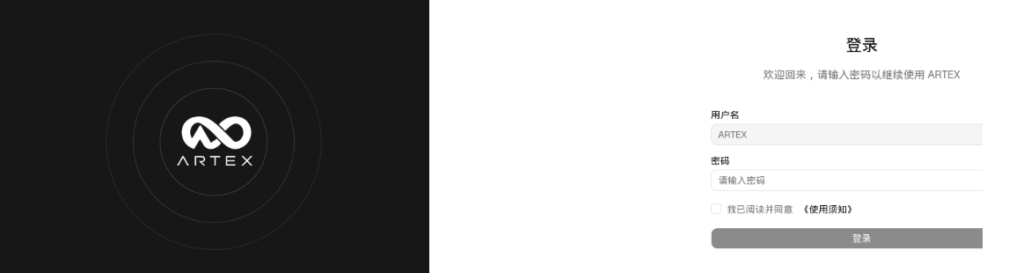
Figure 1. ARTEX login page on the investigated host. The Chinese text reads “Login” and “Welcome back, enter your password to continue using ARTEX”.
The team preserved 29 files from the exposed directory. They hash to 27 distinct SHA-256 values, because cb.log and cb.stdout are identical, as are ldap.log and ldap.stdout. The set includes three test-round scripts, Java source and compiled classes, LDAP and RMI helpers, and the operator-written SUMMARY.md.
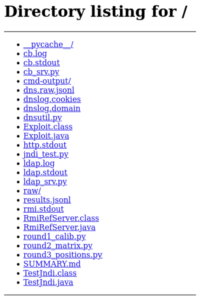
Figure 2. Directory listing of the exposed workspace.
What the filenames tell us
The operator assembled four cooperating components (Figure 3):
If its static initializer ran, Exploit.class would send a CLASSLOADED marker to the callback listener. The test scripts cycled through class names, object positions and request encodings.
The operator’s notes record a successful local LDAP/RMI validation. At least one local test explicitly enabled remote Java codebase loading, a setting current JDKs disable by default. A local success therefore says little about the external target.

Figure 3. The recovered SUMMARY.md lists the LDAP, HTTP, RMI and callback services. A third-party proxy address has been redacted.
Several test requests returned HTTP 500. So did a negative-control request for a deliberately nonexistent class, com.example.NotExistFoo4316 (Figure 4). An HTTP 500 is therefore no sign that the class loaded or that code ran. The LDAP log recorded external search requests and the DNS data showed resolution activity, but neither ties that activity to the target’s Java process. No CLASSLOADED marker appears in the preserved cb.log, ldap.log or http.stdout. The evidence does not show remote code execution.

Figure 4. Control requests returned HTTP 200; a deliberately nonexistent class returned HTTP 500.
A separate output file held 78 findings, each labeled “confirmed” by the platform: 5 critical, 33 high, 31 medium and 9 low. By the platform’s own ratings, 38 of 78 (48.7%) were high or critical. None was independently validated.
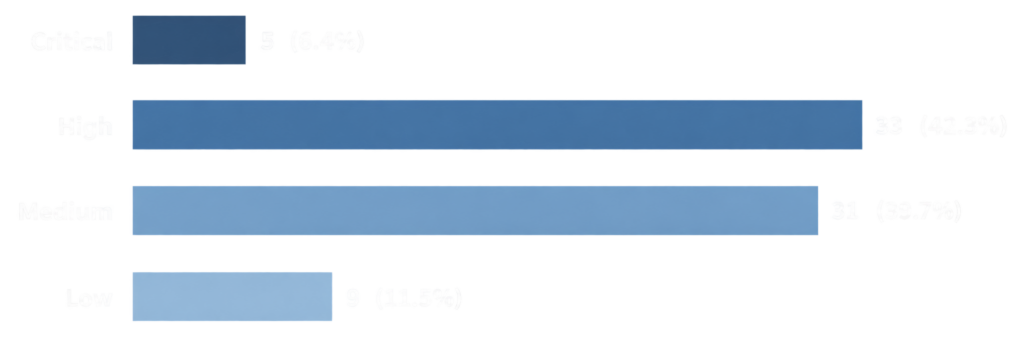
Figure 5. Severity of the 78 platform-labeled findings. None was independently validated.
The findings cover reported authentication, access-control, API and credential-exposure issues; they are not results of the JNDI retest. All 78 records also carry traffic_count = 0. The field is undocumented, so its meaning is unclear.
The recovered files show a methodical operator who instrumented each step of the test:
The ARTEX console, the exposed directory and the callback services all ran on one IP address, 64.176.34[.]176. Both the apex and www hostnames of godliketrenchan[.]com resolved to it. A TLS listener on TCP/443 presented a self-issued certificate with the common name bf4119-beacon, with or without SNI.
The certificate’s SHA-256 fingerprint and common name are stable pivots for internet-wide certificate data and are included in the IOC table. Other internet-exposed ARTEX consoles exist, but a shared product, page size or cloud provider does not establish common control, and the team has not linked any other server to this workspace.
Assessment | Confidence | Basis |
|---|---|---|
The operator used ARTEX to run iterative JNDI injection testing against an external Java application. | High | Test-round scripts, results matrix, operator notes, external LDAP search requests. |
The ARTEX console, test workspace and callback services ran on one operator-controlled host. | High | Shared IP and domain resolution; service list in SUMMARY.md. |
The operator works methodically and builds custom tooling. | Moderate | Hand-written LDAP server, negative controls, external reachability checks. |
The JNDI retest did not achieve code execution on the target. | Moderate | No CLASSLOADED marker in any callback log; HTTP 500 also returned for the negative control. |
The platform’s “confirmed” label does not reflect verified exploitation. | High | No independent validation; the 78 findings are separate from the retest. |
The following indicators were identified during ThreatMon’s investigation on October 23, 2026. They include infrastructure associated with the exposed ARTEX environment, a TLS certificate, and SHA-256 hashes of the recovered Java callback class and JNDI testing script.
These indicators are provided to support threat hunting and infrastructure correlation. They should be evaluated alongside other evidence, as their presence alone does not confirm malicious activity or a successful compromise.
| Type | Indicator (defanged) | Observed context |
|---|---|---|
| IPv4 | 64.176.34[.]176 | ARTEX console, HTTP workspace and callback services. |
| Domain | godliketrenchan[.]com | Resolved to the IP above; ARTEX HTML was recovered through this domain. |
| Domain | www[.]godliketrenchan[.]com | Resolved to the same IP; also recorded as a Host/SNI value in callback records. |
| TLS CN | bf4119-beacon | Common name of the self-issued certificate on TCP/443. |
| TLS SHA-256 | 07654e9c10b01c9274639a45a2ad1d163edad8405add3dc264b0f52bbaab57e3 | Fingerprint of the certificate served on TCP/443. |
| File SHA-256 | 24724c1acd5fcfe1feccde612e09c283676a19b5e227efcad9e4ab382f6b2f45 | Exploit.class, the Java class with the execution-check callback. |
| File SHA-256 | a9d1c5ce2e840a6b6d6bbdfff26ca78dc7f5a45c66667f69c019b9055500d973 | jndi_test.py, the recovered JNDI test script. |
The workspace also used TCP/8000 (class delivery), TCP/11389 (LDAP), TCP/11099 (RMI) and TCP/18080 (callback listener). Shared DNS-logging services, third-party proxy exits, cloud resolver addresses and unrelated ARTEX installations are excluded from the list.
Tactic | Technique | Observed in this case |
|---|---|---|
Reconnaissance | T1595.002 Active Scanning: Vulnerability Scanning | 78 platform-generated findings across authentication, access-control and API issues. |
Resource Development | T1583.001 Acquire Infrastructure: Domains | godliketrenchan[.]com resolving to the workspace host. |
Resource Development | T1587.004 Develop Capabilities: Exploits | Exploit.java compiled to Exploit.class as an execution check. |
Resource Development | T1608.001 Stage Capabilities: Upload Malware | Exploit.class served over HTTP on TCP/8000. |
Initial Access | T1190 Exploit Public-Facing Application (attempted) | JNDI injection retest; execution not observed. |
AI-driven offensive platforms lower the effort needed to run structured exploitation testing. This case shows both sides: the operator ran a methodical, well-instrumented test chain, and the platform still reported 78 “confirmed” findings that its own logs do not back.
For defenders, the indicators and detection guidance above apply now. For anyone assessing AI pentest output, the bar is a traceable request, response and execution signal tied to the target. Here the testing workflow was fully recoverable; remote code execution was not shown.
The ThreatMon Threat Intelligence Team’s analysis relied on preserved files and passive records. No exploitation was reproduced against third-party targets. Sensitive identifiers and request bodies are omitted, and a third-party proxy address is redacted in Figure 3.
The evidence cannot rule out an attempt that succeeded without reaching the callback listener. The meaning of the platform’s traffic_count field is undocumented.

More posts



Share this article
Found it interesting? Don’t hesitate to share it to wow your friends or colleagues
Subscribe to our blog newsletter to follow the latest posts