Mosad is an underground actor that buys, sells and leaks military, intelligence, government and defense-related data, and ThreatMon assesses with high confidence that it is the same operator previously known as JRIntel. Since April 2026, the actor has built a multi-forum and Telegram presence that combines private sales, public leaks, targeted data acquisition and recruitment of insiders and penetration testers.
This post summarizes the ThreatMon Research Team’s adversary profile (TTI-AP-001), based on analysis conducted between 27 and 30 September 2026.
Mosad is a data and intelligence brokerage persona that became visible in April 2026. Its listings cover defense ministries, intelligence services, armed forces, diplomatic entities and aerospace and defense companies. Material includes alleged military documents, personnel records, technical documentation, internal reports and access-related data.
The actor’s motivation appears primarily financial: it prices datasets, negotiates with buyers and offers escrow or trusted middlemen. Financial gain alone does not explain its behavior, however. Free public leaks, targeted collection requests and recruitment point to additional goals of reputation-building and access expansion.
Forum and Messaging Presence
Mosad was observed on bf.st, breached.st, DarkForums, xforums.st and pwnforums. On breached.st, the actor held moderator privileges, indicating an established position in that community. No trace was found on more restricted paid forums such as exploit.in.
Telegram is the actor’s main public-facing layer, organized into three core channels:
Channel | Handle | Function |
|---|---|---|
Data Hoarder | t.me/BraceForBreach | Leak announcements, acquisition requests, recruitment |
Mosad Shop | t.me/mosadShop | Commercial listings, sales and negotiation |
mosad.gov.il | t.me/InsideMossad | Community chat group |
Buyers are routed to private channels through a consistent contact set: Telegram @mosad, Session, Tox, Matrix and Jabber.
From JRIntel to Mosad
The Mosad identity is a deliberate rebrand of the earlier JRIntel persona. JRIntel used a different visual identity and had already targeted Israeli interests, including purported Barak-8 documentation and alleged Mossad personnel data.
The switch may also have served as a reputational reset. In November 2025, JRIntel was the subject of a public scam report on DarkForums over a USD 750 Chinese government webmail/VPN access sale. The buyer was later refunded, but the dispute damaged the JRIntel name. No statement from the actor confirms the rebrand was motivated by this incident.
The strongest evidence that Mosad and JRIntel are one operator comes from forum moderation records, not from stylistic similarity. Four independent lines of evidence point the same way.
The temporal overlap is treated only as supporting evidence: the Mosad forum dataset contains 44 timestamps, and posting times may not reflect the operator’s full day.
Bytecategory, Nyarvexx and Bytecat form a linked account cluster that sits inside Mosad’s ecosystem but likely operates separately from it. The cluster describes itself as a “Black Hat Developer” and publishes Chinese-language technical content on networking, proxy infrastructure, censorship circumvention and security tooling.
The Bytecategory GitHub profile links directly to bytecategory.com, t.me/nyarvexxx, t.me/BraceForBreach and breached.st. That shared BraceForBreach channel, Mosad’s main leak distribution point, is the clearest connection between the two clusters. Mosad has also publicly referenced @bytecategory in technical discussions.
Two factors argue against common control:
ThreatMon assesses that Bytecategory is possibly operationally separate from Mosad/JRIntel, while its association with Mosad’s broader ecosystem is rated Moderate-High confidence. Whether all three Bytecategory accounts belong to a single individual remains unconfirmed.
Mosad runs four activities in parallel, so a single listing rarely tells the whole story.
In its first observed post in April 2026, the actor offered PLA and MSS-related material and described a move from private contracted work toward a more organized structure aimed at serious buyers and think tanks.
Mosad is best assessed as a broker-led hybrid operation (Moderate-High confidence). Its inventory mixes brokered, aggregated and recycled material with potentially insider-derived data. For example, the NATO 2009–2024 collection was openly described as compiled and unclassified, and the tni.mil.id dataset resurfaced after its first publication. Claimed Pakistan Air Force insider information and photographed F-16 documents point to other sourcing paths. Direct intrusion capability has not been independently demonstrated, and the authenticity of the advertised datasets remains unverified.
The listings below are representative of the range of material Mosad handled between May and September 2026. All are actor claims, not verified compromises.
Date | Target | Claim | Model |
|---|---|---|---|
Sep 2026 | U.S. / Pakistan | Photographed F-16 engine design documents, tagged #mosadlivesforever | Public leak |
Aug 2026 | Iran | Personnel data on Ministry of Intelligence officers, IRGC intelligence staff and interrogators | Public leak |
Jul 2026 | SEKISUI Aerospace (defense industrial base) | 70 GB of engineering drawings, STEP files, bills of materials and tooling data | Sale, USD 200,000 |
Jul 2026 | India (DRDO) | 1.7 GB of UAV, SAAW and missile-related material | Sale, USD 10,000 |
Jul 2026 | Pakistan | 8.88 GB of Pakistani Embassy in Türkiye data and 670 MB of DGMP data, plus claimed MoFA email, SSL VPN and NADRA RCMS access | Sale, offers |
May 2026 | Russia (FSB) | Document on countering Ukrainian military, scientific and technical intelligence | Public leak |
May 2026 | United States | Collection attributed to DoD, CIA, DHS, courts and DIA | Sale, budget-based |
The SEKISUI and Pakistan listings illustrate two concerns for defenders: supplier engineering data commanding six-figure prices, and claimed live access to diplomatic mailboxes and VPNs.
Mosad’s targeting is broader than JRIntel’s, and China replaced the United States as the most frequent target.
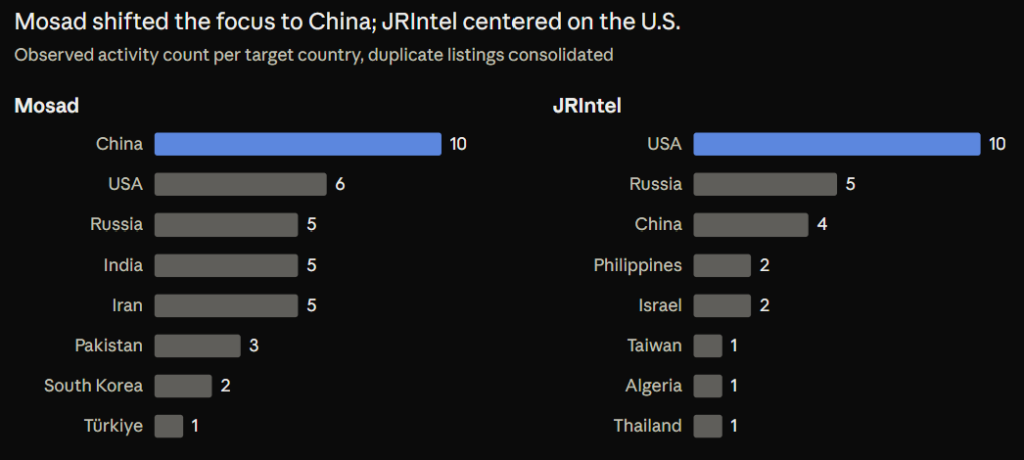
China dominates Mosad’s military, intelligence and large-scale data listings, while Russia, India and Iran form a second cluster of document leaks and personnel data. JRIntel’s narrower spread was weighted toward U.S. military and government material.
Mosad poses risk both through the material it distributes and through its continuing effort to acquire new access. The organizations most exposed are:
Mosad is a persistent, military-focused data and intelligence brokerage operation that evolved from the JRIntel persona and now spans five forums and three Telegram channels. Its claims are often unverified or recycled, but its active recruitment of insiders and penetration testers means the threat extends beyond resale. Organizations in defense, government and the aerospace supply chain should treat Mosad listings as a trigger for validation, access review and continued monitoring.
ThreatMon continues to track Mosad, JRIntel and the Bytecategory cluster. For the full adversary profile (TTI-AP-001), contact info@threatmonit.io.

More posts



Share this article
Found it interesting? Don’t hesitate to share it to wow your friends or colleagues
Subscribe to our blog newsletter to follow the latest posts