October 2026 investigations placed ARTEX, an AI-assisted offensive-security framework, inside several real-world intrusion campaigns. One involved Vapor Panda, a China-nexus actor targeting government and high-value commercial organizations. Another involved Storm-0940, which used compromised third-party application identities to pursue access to Microsoft 365 tenants. These are separate campaigns: use of the same framework does not establish a common operator.
The significance lies less in any new exploit than in how existing methods can be coordinated. Stolen credentials, exposed applications, cloud reconnaissance and privilege changes can be tested in parallel, with less manual work between each step. The reported scale also needs context: a targeted organization is not necessarily compromised, and a successful sign-in does not by itself establish data access or theft.
ARTEX is a Go-based, multi-agent penetration-testing framework with a web interface. A coordinating agent delegates work to planning and execution agents, while a shared graph retains discovered assets, relationships and prior task results. Instead of restarting reconnaissance after each result, the workflow can use what it already knows to select another path. Public incident-response research has described several specialized agents carrying out cloud, application and identity-focused tasks.
The framework is not necessarily operating without human direction. In the published Vapor Panda investigation, recovered transcripts showed an operator issuing instructions in Chinese to deploy web shells, obtain privileged credentials and locate machines lacking endpoint protection. The agents primarily used DeepSeek and a second, unidentified commercial model. In one intrusion, planning agents consumed approximately 1.4 billion input tokens—a measure of model processing, not of data stolen.
Between 17 and 27 October 2026, researchers observed a single ARTEX controller directing activity against more than 200 organizations in at least 14 countries. Targets included foreign ministries, other government bodies, telecommunications providers and organizations in the pharmaceutical, semiconductor, defense and financial sectors. Investigators confirmed post-exploitation at nine organizations and reported credential scanning or password spraying against at least 12 more. These numbers describe different levels of observed activity and should not be treated as a count of 200 breaches.
The recovered engagements illustrate how agents moved between environments without following one fixed playbook:
The ThreatMon perspective: these intrusion paths make external exposure a practical investigation priority. ThreatMon Attack Surface Intelligence helps teams identify and prioritize internet-facing assets and potentially exposed management interfaces; ThreatMon Dark Web Intelligence can add context when organizational credentials appear in monitored sources. Neither finding proves intrusion on its own, but each can direct defenders toward the affected service and responsible owner.
The six-stage cloud kill-chain model provides a useful way to organize the reported Vapor Panda intrusion paths. The table is a representative synthesis of separate engagements, not a claim that every target experienced every stage or that all actions occurred in this order.
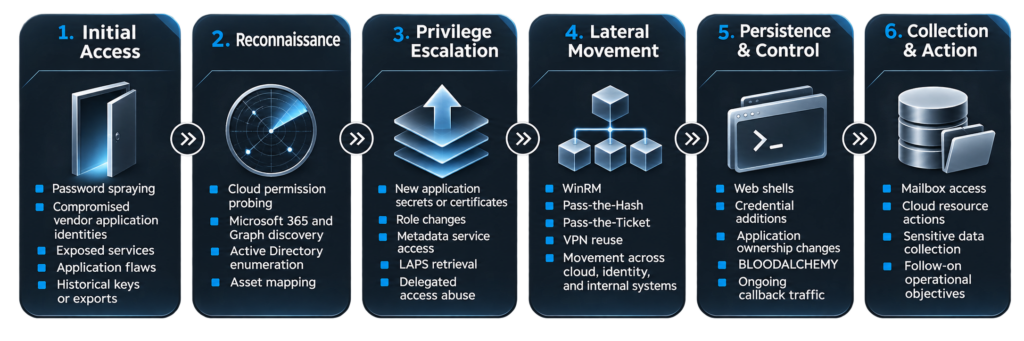
ThreatMon assessment: the most valuable intervention points are the transitions between stages: from an exposed service to privileged access, or from a trusted identity to another system. External exposure and supplier intelligence help prioritize where to look; identity, endpoint and network evidence determines how far an attacker progressed.
The second campaign exposed a different problem: access already granted to a trusted third-party application. A Microsoft investigation linked Storm-0940 to ARTEX-assisted attacks involving compromised application identities associated with ConnectWise Cloud Backup, formerly SkyKick. Those identities could attempt to authenticate to customer environments without an interactive employee sign-in.
Between 10 and 14 October, activity associated with this campaign generated more than 151,000 failed sign-ins against 327 accounts at eight organizations, peaking at approximately 2,900 attempts per minute. No successful authentication was observed in that specific password-spraying episode. After the ConnectWise compromise, separate attempts reached more than 2,250 Microsoft 365 customer tenants. In some environments, follow-on activity included Microsoft Graph reconnaissance, application credential changes and attempts to modify privileges. The tenant count measures attempted access, not confirmed compromise.
A separate investigation of the same ConnectWise incident confirmed unauthorized application sign-ins in 162 tenants as of 16 October. In one tenant, a related Cloud Management application assigned itself Global Administrator privileges and modified credentials on other applications in a sequence lasting approximately five minutes. Importantly, that investigation did not establish that the role changes and later Cloud Backup sign-ins were performed by the same operator, nor did it independently verify that ARTEX or an LLM controlled those actions. These findings add incident context; they are not direct proof of additional ARTEX activity.
The primary risk is access that survives the original incident. An attacker who adds a new secret to another application or expands a privileged role may retain a path into the tenant after a vendor credential is rotated. Disabling the original integration is necessary but may not be sufficient. ConnectWise’s tenant-investigation guidance accordingly calls for checks within affected customer environments.
For organizations that depend on privileged cloud integrations, ThreatMon Supply Chain Risk Management helps prioritize vendor-related exposures and relevant third-party risks. ThreatMon Cyber Threat Intelligence can place reported infrastructure and techniques in campaign context. These external signals guide investigation; Microsoft Entra sign-in and audit logs are still required to establish whether an application authenticated, what it accessed and whether persistence was created.
Separate incident-response research on ARTEX illustrates why automation should not be confused with stealth. The following observations came from different investigations, not from a single Vapor Panda or Storm-0940 intrusion:
Agents can fail, retry and run overlapping actions. Those behaviors may create abrupt clusters of permission checks, unusual application requests, short-lived files and identity changes. A generic user-agent, high request rate or use of the shared webhook.site service is not sufficient on its own to attribute an incident to ARTEX.
We assess ARTEX primarily as an intrusion accelerator, rather than a fundamentally new method of bypassing security controls. Confidence is high in the broader acceleration trend because it appears across separate public investigations; confidence in any particular actor’s involvement depends on the evidence available for that campaign.
Three implications stand out.
Permission boundaries determine the damage. ARTEX can coordinate attempts, but a stolen application identity, an overprivileged cloud role or an old signing key determines what an attacker can reach. Least privilege, credential rotation and isolation remain relevant precisely because they limit the consequences of fast-moving abuse.
Automation reduces the defender’s decision window. A dense series of alerts is useful only when a team can identify the affected identity, understand its permissions and revoke unauthorized access. The ConnectWise findings demonstrate why non-human identities and vendor-owned applications need the same incident-response ownership as privileged employee accounts.
Attribution should follow evidence, not the tool name. ARTEX is reusable software. An artex process argument or probe file can help direct a hunt, but it does not establish Vapor Panda or Storm-0940 attribution. Infrastructure, authentication records, follow-on behavior and the wider operational context must agree.
The following is a ThreatMon analytical mapping of reported behaviors. Different entries may relate to different investigations.
Observed behavior | MITRE ATT&CK |
Microsoft 365 password spraying | T1110.003 — Password Spraying |
Use of compromised cloud application identities | T1078.004 — Valid Accounts: Cloud Accounts |
Credentials added to existing cloud applications | T1098.001 — Additional Cloud Credentials |
Privileged cloud role assigned to an application | T1098.003 — Additional Cloud Roles |
Web-shell deployment | T1505.003 — Web Shell |
Kerberoasting and DCSync in separate cases | T1558.003 — Kerberoasting; T1003.006 — DCSync |
The following indicators of compromise (IOCs) are grouped by campaign to preserve attribution context. Network values are defanged; confirm their current relevance and corroborating events before blocking.
Storm-0940 — reported network activity
Indicator | Investigation context |
144.172.64[.]99 | Password spraying and related affected-application activity |
144.172.64[.]60 | Application sign-in / Microsoft Graph investigation |
144.172.64[.]128 | Affected application sign-ins / Graph activity |
187.15.88[.]186, 187.15.90[.]217, 187.15.89[.]186 | Transient Graph-related activity, especially 15–16 October |
Vapor Panda — BLOODALCHEMY infrastructure and files
Indicator | Type / context |
nginxmysql[.]com / 45.153.126[.]223 | C2 domain and associated IP |
sqlserver-sqlite[.]com / 89.46.234[.]50 | C2 domain and associated IP |
www[.]ddduuuppp[.]com / 192.121.47[.]20 | C2 domain and associated IP |
49fe70419fd19b81ca8d730a6ef7c1ec71b681d60b390761070d42686c7d2068 | SHA-256, GameHook executable renamed svchost.exe |
3fb5a9fb3e2cb1d6208966bd4e55d10282d19c7250d827efa560463d60a12ee4 | SHA-256, loader graphics-hook-filter64.dll |
364251838edfcf5ef1107fa692da3c5bd9a540482449f645992830134bf807ab | SHA-256, payload graphics-hook_config.bin |
Additional hunting leads include C:\ProgramData\artx5v\, artx/`artex` process arguments, artex-probe-* files, ArtexProbe account names and unexpected new application credentials or cloud role assignments. These indicators require context; shared infrastructure and generic tooling should not become indiscriminate blocklists.
ConnectWise application IDs are not malicious indicators. The vendor’s guidance identifies seven affected application identities. The full current vendor list should be used during tenant review rather than relying only on a sample detection query. This distinction is important: an application may be legitimate even when its credentials were abused.
The operational challenge is connecting an external warning to a response decision. ThreatMon supports that first step through four complementary intelligence views: Attack Surface Intelligence for external assets and interfaces, Supply Chain Risk Management for third-party exposure, Dark Web Intelligence for potentially leaked organizational credentials, and Cyber Threat Intelligence for actor context and reported indicators.
Consider a company relying on a privileged cloud-backup integration. A supplier-related finding or a relevant credential-exposure alert can prompt its security team to identify the affected application, locate its owner and review the relevant campaign indicators. Investigators can then check service-principal sign-ins, Microsoft Graph operations, consent grants, new application credentials and privileged role assignments. In a web-application scenario, the same process begins with an exposed asset and continues through web, endpoint and cloud logs.
ThreatMon helps teams find and prioritize the external lead; internal security telemetry establishes what actually happened. Preserve relevant evidence before remediation and follow vendor-specific instructions when trusted integrations are affected. The goal is a verified scope of access and a clear containment decision—not simply an additional alert.
ARTEX did not introduce password spraying, web shells or cloud privilege abuse. What October’s investigations demonstrate is the ability to combine and repeat those familiar techniques across many targets at speed. Vapor Panda showed the value of parallel intrusion paths; Storm-0940 highlighted how a compromised integration could extend access across customer tenants; other incidents showed that automated workflows can also leave conspicuous forensic traces.
Defenders should focus on exposed services, overprivileged application identities and historical credentials—and know who can contain misuse. ThreatMon connects external exposure, leaked-credential and supplier-risk intelligence with campaign context, helping teams decide where to investigate first. Internal evidence determines actual compromise and containment.

More posts



Share this article
Found it interesting? Don’t hesitate to share it to wow your friends or colleagues
Subscribe to our blog newsletter to follow the latest posts