Open Ports: The Invisible Doors on Your Attack Surface
An organization’s external attack surface is not static. New servers are deployed, cloud resources appear, applications move between environments, firewall rules change, and temporary services can remain exposed long after they are needed. One of the clearest signals of this shifting exposure is an open network port.
An open port is not automatically a vulnerability. It is evidence that a service is reachable from a particular network location. If that service is unnecessary, improperly configured, outdated, weakly authenticated, or vulnerable, the exposure becomes a meaningful security risk. That visibility is exactly why open-port monitoring belongs in any Attack Surface Management (ASM) program.
Open Ports ≠ Vulnerabilities (But They’re Related)
Think of an IP address as a building and a network port as a numbered entrance to a specific service inside. Different applications listen on different ports. A public HTTPS service on port 443 might be entirely expected. An unauthenticated MongoDB on port 27017 probably isn’t.
NIST’s least functionality principle is straightforward: configure systems to allow only the ports, protocols, and services needed for their intended purpose. Open ports and available services can be attractive targets, especially when known vulnerabilities are attached to them.
Why Attackers Care About Exposed Services
External reconnaissance usually starts with discovering what an organization exposes to the internet. Open ports can reveal web servers, remote administration services, databases, management interfaces, and other technologies. Service identification and version information then provide additional context for vulnerability research.
CISA describes reconnaissance as a stage where threat actors characterize a target’s perimeter, including internet-facing servers and open communication ports. This makes external visibility both a defensive requirement and an offensive concern.
When Internet Exposure Becomes a Real Problem
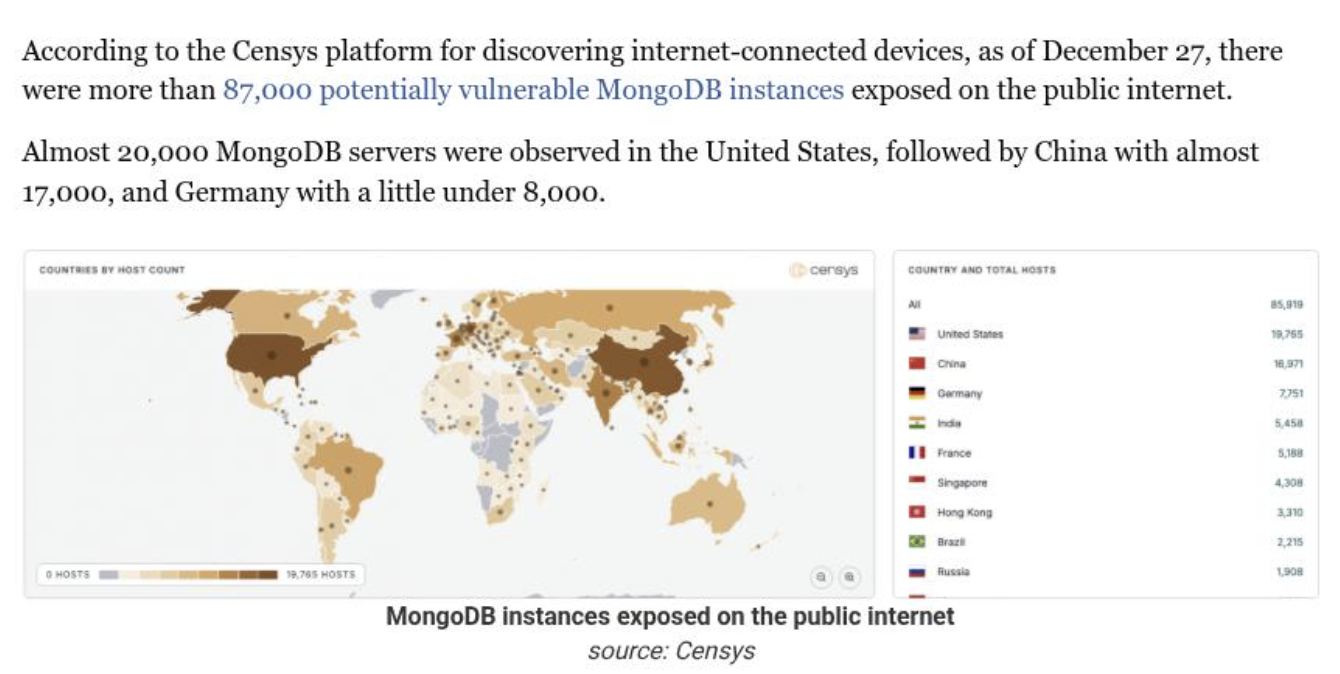
Two widely documented cases show why open-port visibility matters: the 2016–2017 MongoDB ransom attacks, where internet-exposed databases were accessed without adequate authentication, and BlueKeep, where internet-facing RDP services could expose vulnerable Windows systems to remote code execution.
MongoDB: Exposed Database Services
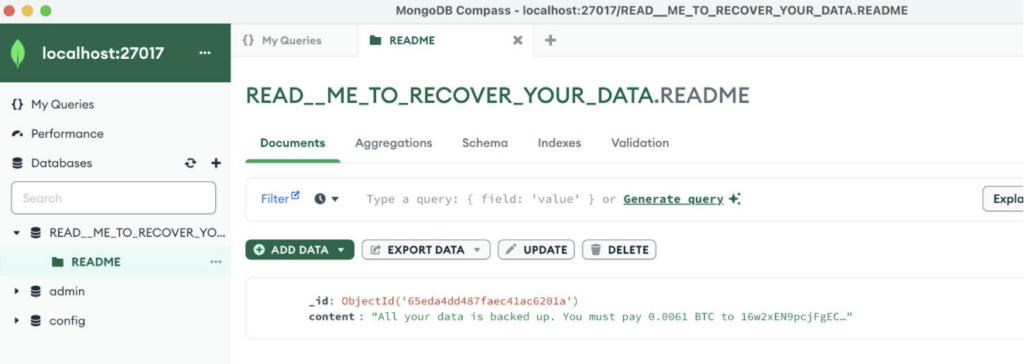
In January 2017, security researchers reported a large-scale wave of attacks against MongoDB databases that were accessible from the internet with no password on the administrator account. BleepingComputer reported that the number of hijacked MongoDB servers rose from approximately 10,500 to more than 28,200 within days. Attackers accessed exposed databases, exported or deleted data, and left ransom demands.
The root cause wasn’t MongoDB itself. In most cases, the database had simply been left bound to 0.0.0.0 instead of 127.0.0.1, and authentication was never enabled. A database service that isn’t intended for public access becomes a high-value target when it’s directly reachable from the internet without protection.
BlueKeep: RDP Exposure + Critical Vulnerability
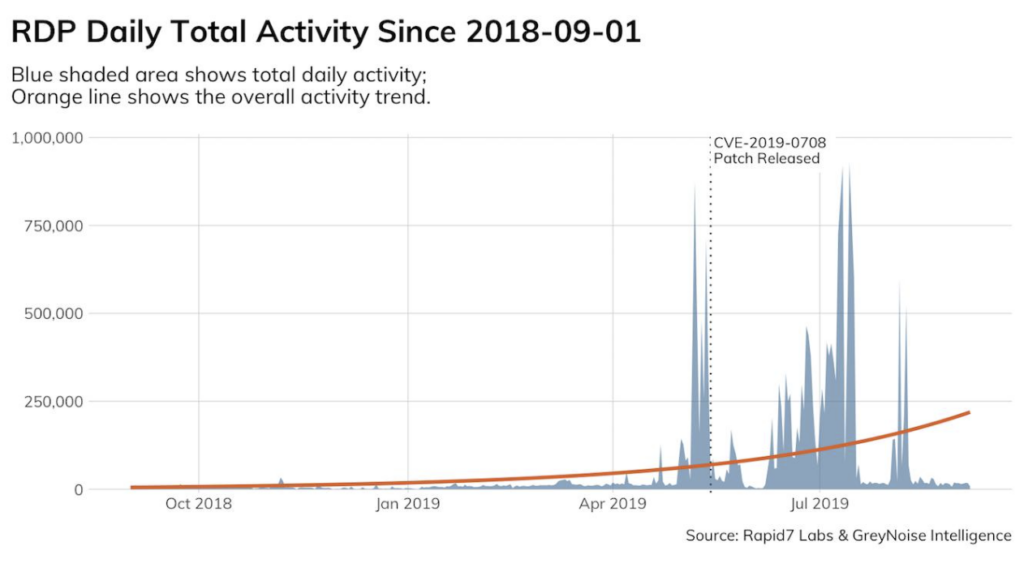
CVE-2019-0708, commonly known as BlueKeep, affected Remote Desktop Services on vulnerable Microsoft Windows systems. CISA warned that exploitation could allow remote code execution without user interaction and described the vulnerability as potentially wormable.
Microsoft later reported that attacks involving a BlueKeep exploit module were likely initiated by scanning for vulnerable internet-facing RDP services. The company observed a substantial increase in RDP-related service crashes after the Metasploit module was released, underscoring why teams need to know which remote-access services are exposed.
CISA’s mitigation guidance included applying available patches, disabling unnecessary services, enabling Network Level Authentication where applicable, and blocking TCP port 3389 at the enterprise perimeter when RDP access wasn’t required externally.
The ASM Problem: Exposure Changes
The most important issue is often not that an organization has an open port, but that nobody notices when the external attack surface changes.
Consider an application that exposes only HTTPS on Monday. A deployment on Wednesday introduces a management service on another port. If the security team is unaware of that change, the organization continues operating with an inaccurate view of its public exposure.
ASM extends beyond periodic vulnerability scanning because CISA guidance for internet-accessible systems emphasizes including internet-accessible applications in assessment scope and maintaining visibility into exposed systems. CISA also recommends eliminating unnecessary exposed ports and services on public-facing assets and reviewing them regularly.
From Vulnerability Management to Attack Surface Management
Traditional vulnerability management often begins with an asset inventory and then searches those assets for known weaknesses. ASM adds an earlier question: what assets and services are actually visible from the outside?
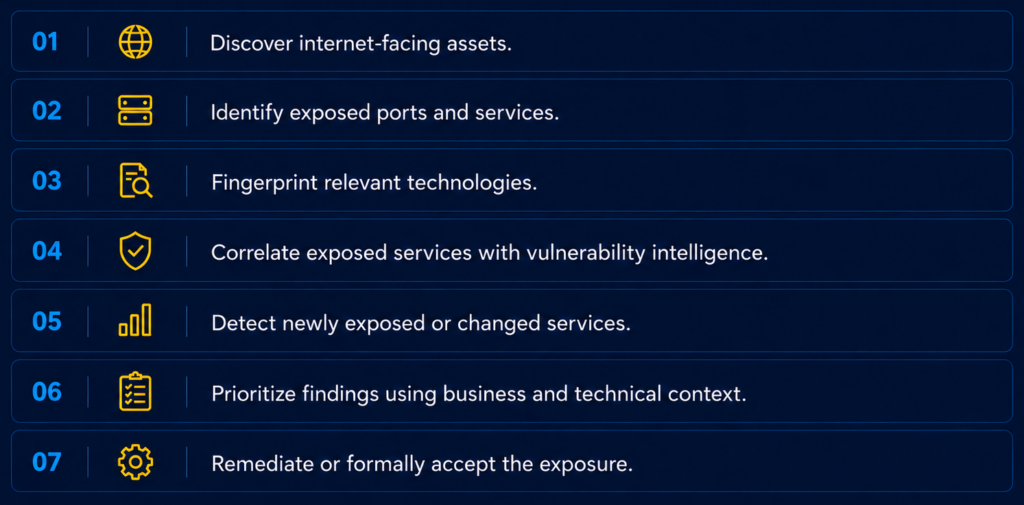
A Practical ASM Workflow
How ThreatMon Detects Unknown Exposure
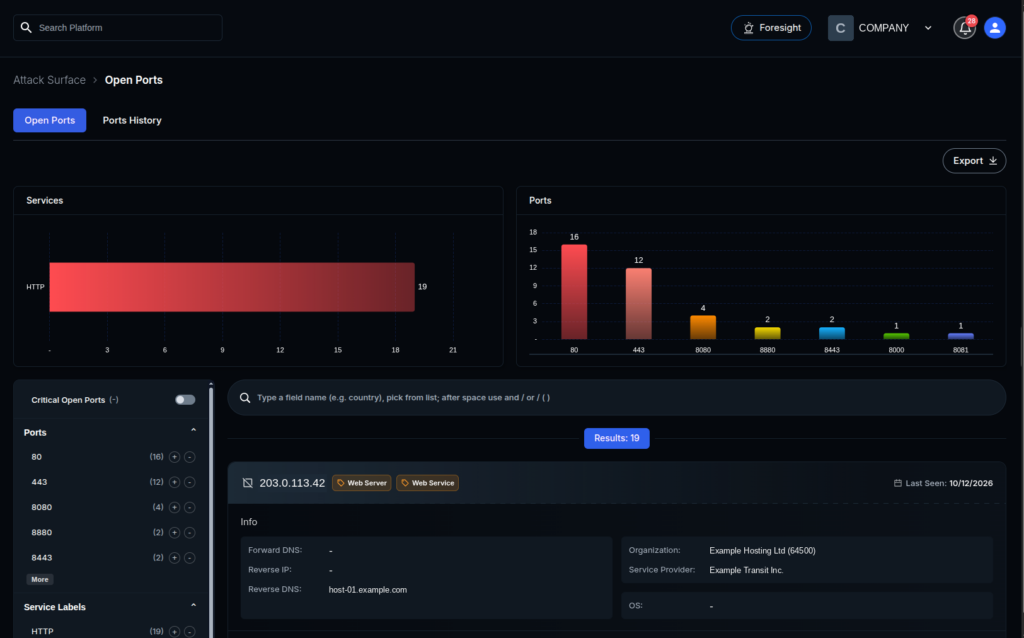
ThreatMon treats open ports not as errors to be deleted, but as signals to be understood. We help teams monitor open ports as part of an organization’s external attack surface, focusing on how that exposure evolves over time.
Asset Discovery: Identify internet-facing domains, subdomains, IP addresses, and related assets.
Open-Port Discovery: Identify externally reachable ports across discovered assets and build visibility into the services exposed to the internet.
Service Identification: Determine the service or technology associated with an exposed port where fingerprinting information is available, providing context beyond the port number itself.
Change Detection: Detect newly exposed ports, closed ports, or changes in observed external services so teams can identify attack-surface changes that may otherwise go unnoticed.
Risk Context: Correlate exposed services with service type, technology, known vulnerabilities, asset context, and other security signals to help distinguish expected exposure from potentially risky exposure.
Alerting: Surface significant exposure changes and newly observed services so they can be investigated and, where necessary, enter the remediation workflow.
Reducing Unnecessary Internet Exposure
Organizations can reduce exposure by taking these steps:
Disable unused services
Restrict administrative interfaces (VPN, bastion hosts, or VPC peering)
Enforce strong authentication on all internet-facing services
Patch internet-facing software on a regular schedule
Review public-facing ports quarterly and remove what isn’t needed
NIST and CISA both emphasize reducing unnecessary functionality and exposed services. CISA’s remote-access guidance also identifies External Attack Surface Management (EASM) as a way to improve visibility across systems and infrastructure.
Why Continuous Visibility Matters
A point-in-time scan provides a snapshot of your external exposure. But that snapshot can quickly become outdated. New services go live, firewall rules change, and development systems can remain accessible long after they’re needed. These changes may expose services that were never intended to be publicly accessible.
Continuous visibility helps security teams spot these changes as they happen, investigate unexpected exposure, and determine whether an exposed service needs attention. Rather than relying on periodic scans alone, organizations can maintain a more current view of their internet-facing assets and services.
Conclusion
Open ports aren’t inherently a security problem. What creates risk is exposure that is unnecessary, poorly understood, or changes without the security team’s knowledge. A service may be intentionally exposed and securely configured, while another may appear on the internet because of a deployment, firewall change, or forgotten system.
For security teams, open-port monitoring is less about finding ports and more about maintaining an accurate view of external exposure. Knowing which services are reachable, understanding their context, and detecting changes over time gives teams the information they need to decide whether action is required.
Attack Surface Management brings this visibility into a continuous process rather than treating exposure as a point-in-time scan. The objective is to keep the organization’s external footprint understood as infrastructure evolves, so that significant changes don’t remain unnoticed.
What can the internet see about your organization right now, and what changed since yesterday?