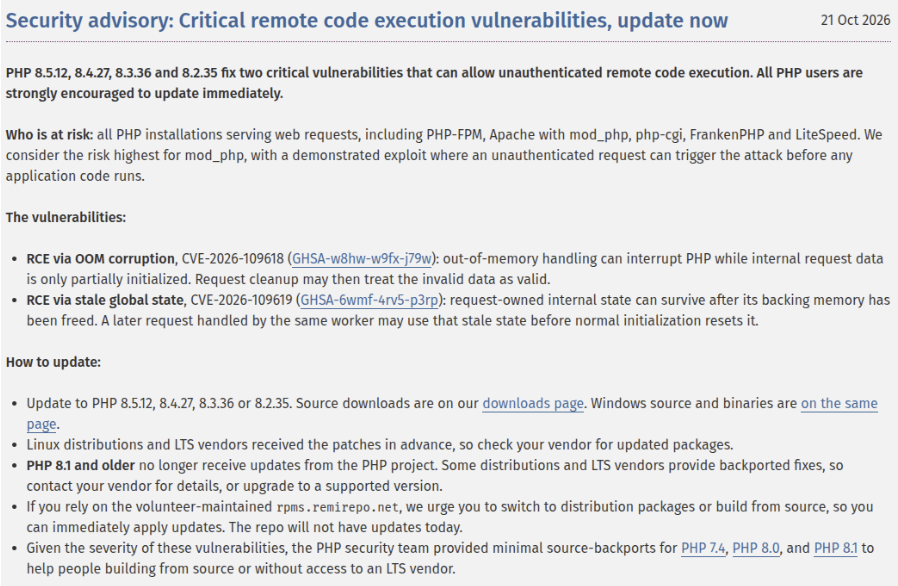
On October 21, 2026 the PHP project shipped emergency fixes for two critical flaws, CVE-2026-109618 and CVE-2026-109619. Researchers call the pair PHP2Shell, because together they let someone who can only send ordinary web requests end up running code on the server, with no login.
The bugs are in the PHP engine, not in any one application. WordPress, Drupal, Magento and everything else written in PHP is exposed through the runtime underneath it, so updating the application does not close the hole. The story is also messier than most disclosures. Two teams found the bugs independently, the details leaked a day before the planned fix, and Amazon says it saw an attack attempt four days before PHP released anything. If you run PHP anywhere, this is a patch-today problem.
Who is affected
If PHP serves web requests on your servers, assume you are affected until you have checked. Wiz says even a “Hello World” app on an affected version can be vulnerable. Check the binary that actually serves the web, because php -v may only show the command-line version.
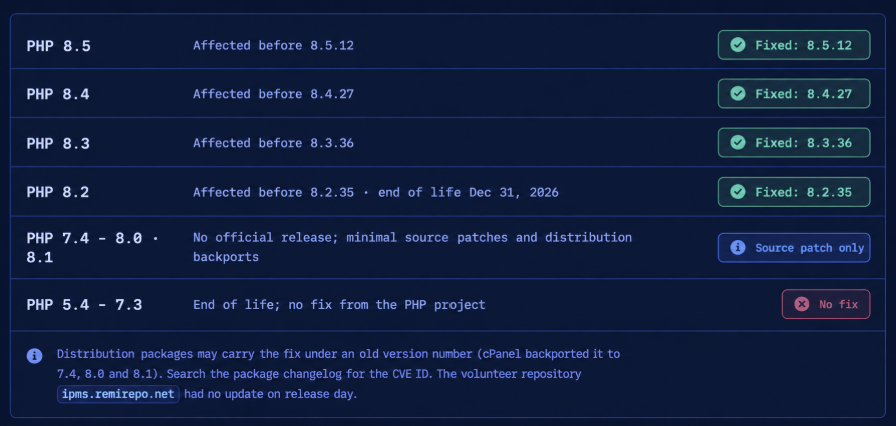
Distribution packages may carry the fix under an old version number, so a low version string is not proof you are exposed, and a high one is not proof you are safe. The reliable check is the package changelog.
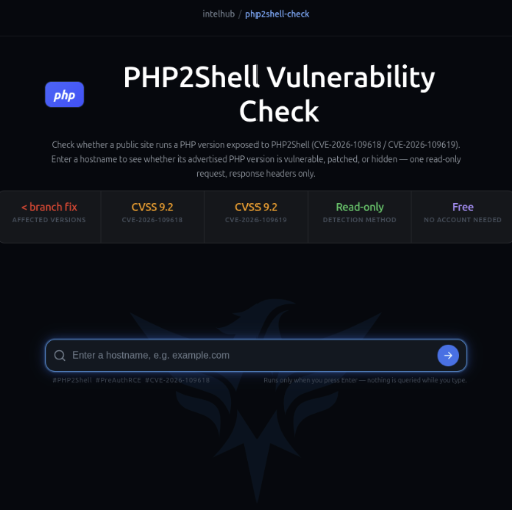
ThreatMon’s free PHP2Shell Vulnerability Check reads the response headers of a single request and shows whether a site’s advertised PHP version is vulnerable, patched or hidden. This makes it a quick, convenient first check. Because it relies only on what the server advertises, it is a preliminary assessment rather than a definitive vulnerability verification.
What happened, in order
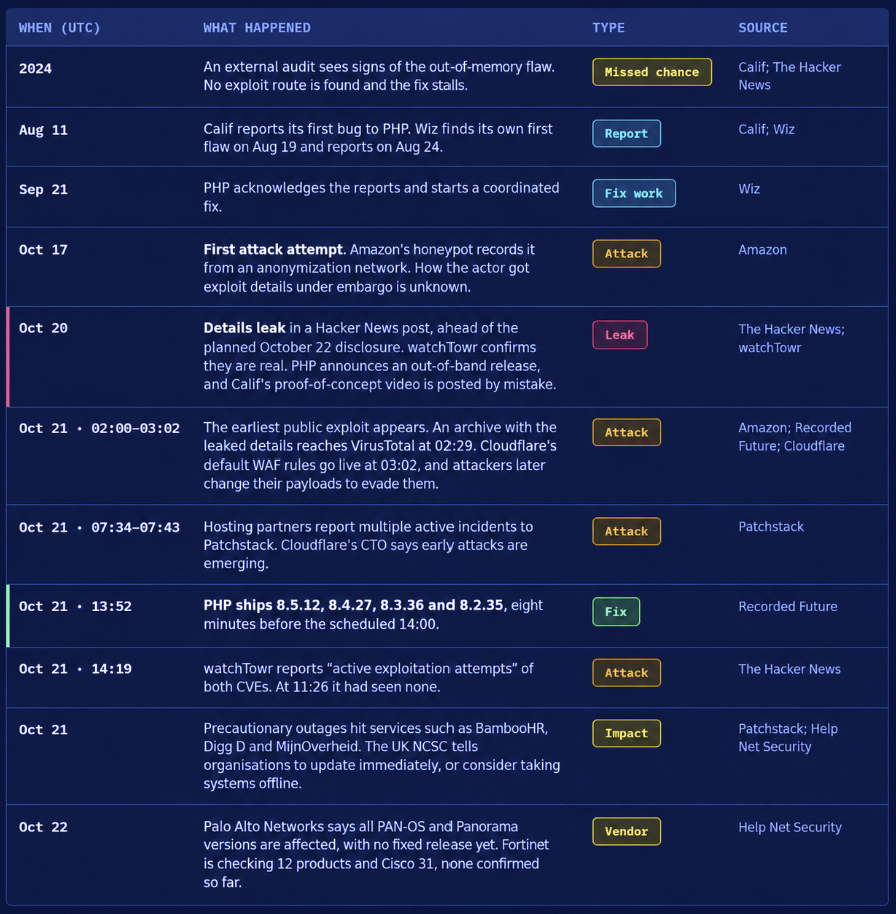
Calif found several independent ways to get code execution on August 1 and reported the first bug to PHP on August 11. Wiz, working separately, found its first flaw on August 19 and reported on August 24. PHP acknowledged the reports on September 21 and started a coordinated fix, with disclosure planned for October 22.
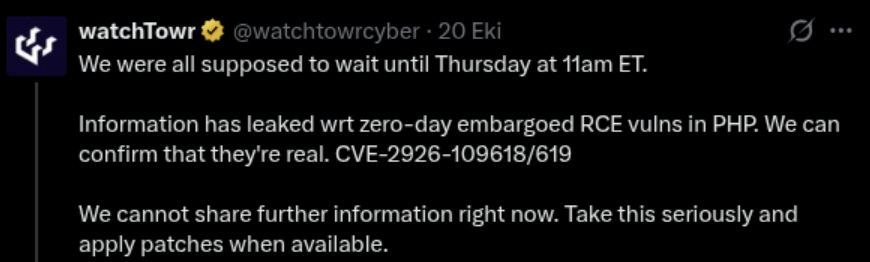
Then the embargo broke. On October 20 a Hacker News post leaked the details, watchTowr confirmed they were real, and that evening Calif’s proof-of-concept video was posted by mistake. PHP moved its release up to October 21. Attackers were already ahead of it: Amazon’s honeypot recorded an attempt on October 17, three days before the leak and four days before the fix. Amazon does not know how that attacker got exploit details while the bugs were under embargo.
watchTowr on X, October 20: the firm vouches for the rumored flaws before any technical detail is public. Source: watchTowr on X.
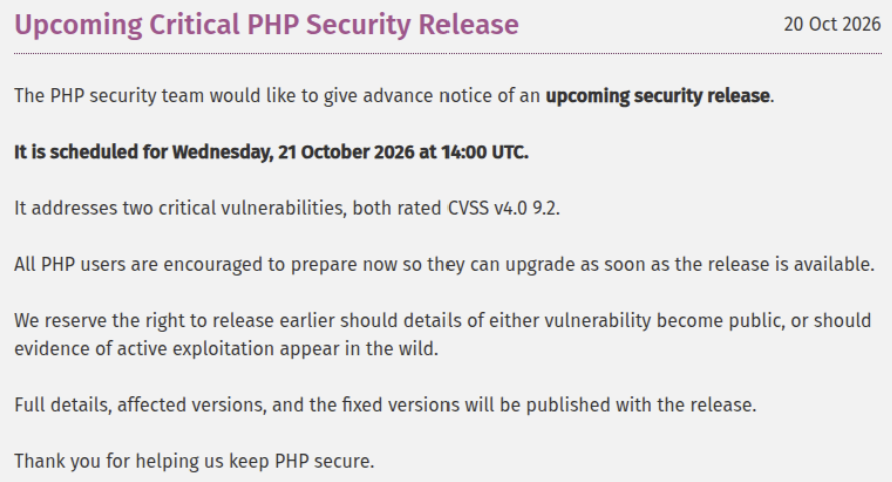
php.net, October 20: PHP tells users to prepare for a critical release the next afternoon, without naming the CVEs yet. Source: PHP.
Release day was a race. The earliest public exploit appeared around 02:00 UTC, Cloudflare switched on default firewall rules at 03:02, hosting companies were reporting attacks to Patchstack by 07:34, and PHP shipped the fixes at 13:52. By 14:19 watchTowr was reporting exploitation attempts of both CVEs.
Key Events
The two CVEs side by side
CVE-2026-109618
CVE-2026-109619
In plain terms
PHP runs out of memory while a request is half set up, and cleanup treats the unfinished data as valid.
State from one request outlives its freed memory, and a later request on the same worker uses it.
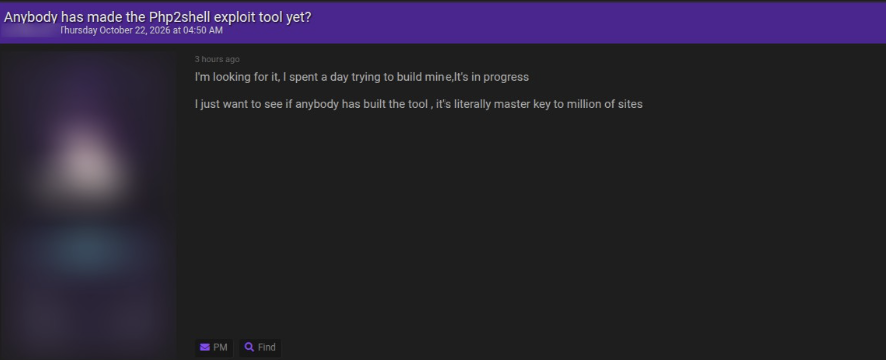
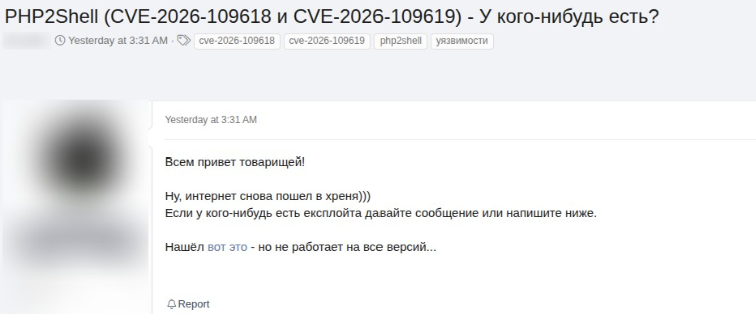
ThreatMon’s Cyber Threat Intelligence team watched forums and Telegram channels on October 21 and 22. It found requests for ready-made exploits, GitHub links presented as proofs of concept, a Python code excerpt and a reposted tool demonstration. Nine screenshots were grouped into eight observations.
The posts show interest in the flaws and circulation of tools. They do not show that any shared code works, and they do not show that a real target was compromised. The screenshots also do not show whether the forums can be reached through the dark web, so we call the sources forums and Telegram.
Requests for a ready-made tool
Forum (English): the user asks for a ready-made tool and mentions their own developmentattempt. No successful exploitation output is shown.
Forum (Russian): an exploit request with a claim that the example found does not work on all versions. That claim is not a validated compatibility test.
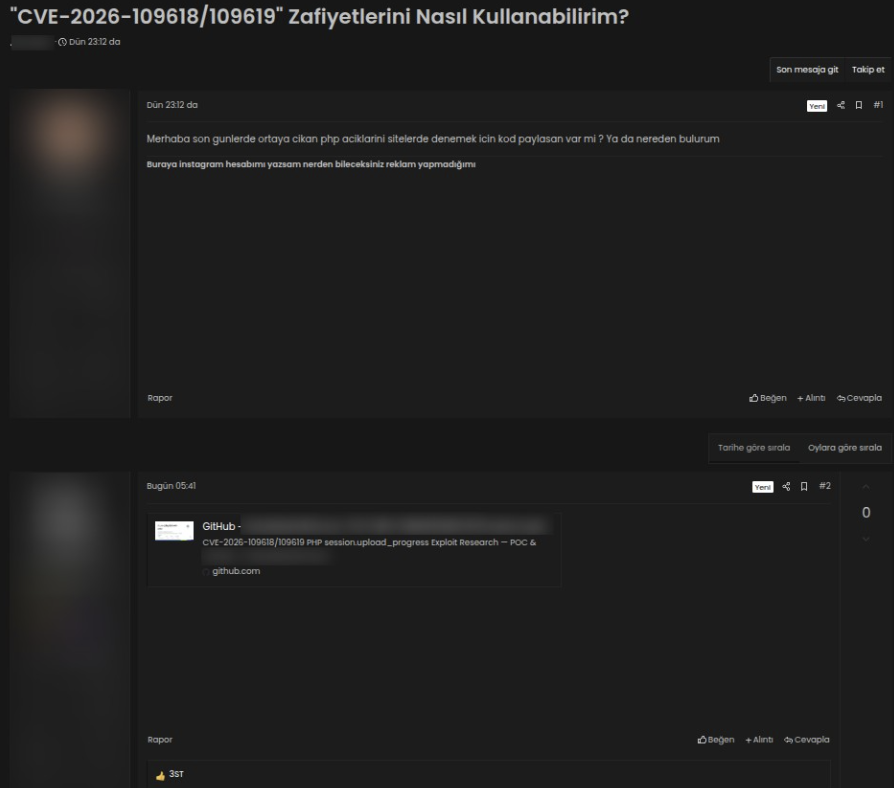
Forum (Turkish): a thread asks for code to try the vulnerabilities on websites. A reply links to repository A, and no working exploit output is shown.
Code and PoC links
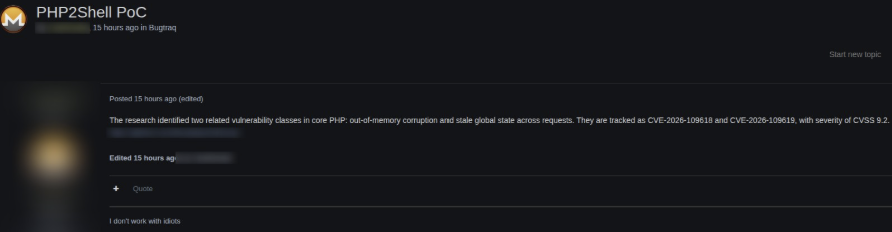
Forum (English): a short summary of both CVEs and a link to repository A.
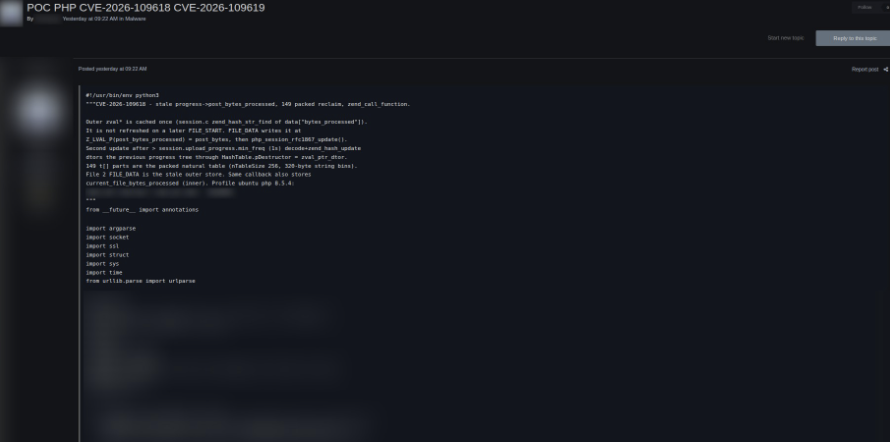
Forum (English): the excerpt references session.upload_progress and memory operations under a title naming both CVEs. The full code and the claimed exploitation chain could not be verified.
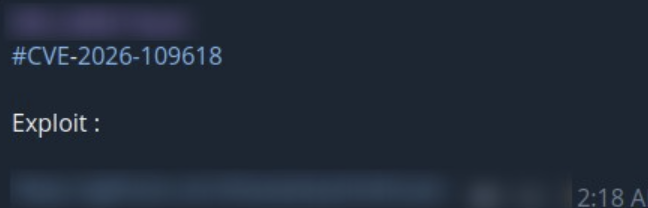
Telegram: repository A is shared with a CVE tag and an exploit label.
Warnings and reposted references
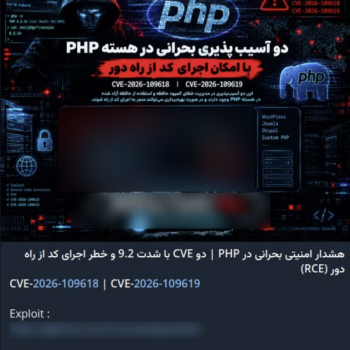
Telegram (Persian): an RCE warning, repository B and target-discovery dorks. This is not evidence of use against a real target or of successful exploitation.
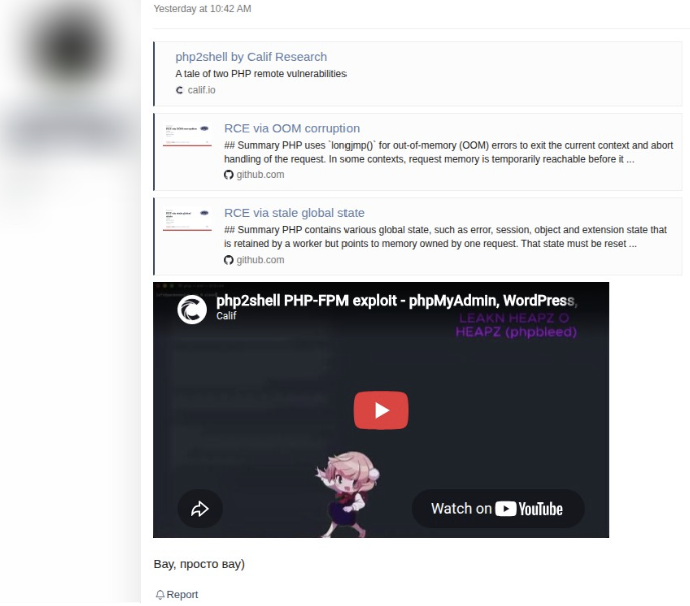
same Russian thread: links to Calif research, two official security advisories and a PHP-FPM video. The preview does not show an exploit run by the person sharing it. Screenshots: ThreatMon Cyber Threat Intelligence.
What the shared code shows
Two public GitHub repositories were passed around in these posts: the main PoC repository, which three of the posts link to, and a second one linked from a Telegram warning. Both are fairly cautious about themselves. The main one lists several attack chains and some detection resources, and says some chains need extra application conditions. The second says outright that version fingerprinting alone does not prove remote code execution. These are the publishers’ own statements, not independent tests.
The posts add little on their own. The Python post shows only an excerpt of a script, and the tool demo stops at 24% during a memory disclosure stage, with no command execution on screen. ThreatMon read the repositories to see what was circulating and did not run their code. We do not link them, and anything like them should be treated as untrusted code.
What this means for defenders
The activity shows demand for exploits and the same few links shared again and again. It does not show a successful attack or any data leaving a system. Cloudflare separately reported traffic aimed at these flaws on its network, and that does not show that the people in these screenshots succeeded.
A public tool does not have to work to draw attention, so do not wait for proof that one works before you check your logs. Review them from October 17 onward, using the hunting signals in the Defender playbook below.
How the evidence was handled: user and channel identities, profile details, direct PoC links, demo target details and operational code details are masked in the screenshots. Technical context and visible timestamps are kept, and lab addresses that appear are not indicators of compromise. Where a forum showed “yesterday” or “today”, we replaced it with October 21 or 22.
How to fix it
The fix is the same everywhere: run a PHP build that contains the patch, then restart whatever serves PHP. Updating WordPress or another application does not fix it.
On shared or managed hosting, ask your host to confirm in writing that both CVEs are fixed, either in 8.5.12, 8.4.27, 8.3.36 or 8.2.35 or by a backport, because a version string alone proves nothing for backported packages. On your own Linux server, update with your package manager (sudo apt update && sudo apt upgrade or sudo dnf upgrade ‘php*’), check the changelog for the CVE (apt changelog php8.3-fpm | grep 109618), then restart PHP-FPM and Apache. With Docker or Kubernetes a restart does not help: pull a rebuilt image with the patched PHP and redeploy it everywhere, staging included.
If you run PHP 8.1 or older, ask your vendor for a backport, build from the PHP security team’s source patches, or move to a supported branch. PHP 8.2 ends support on December 31, 2026, so plan beyond it. Appliances that bundle PHP should stay off the internet until the vendor ships a fix. If you cannot patch yet, apply the interim settings in the playbook below, keep a WAF in front as a stopgap, and take high-risk servers offline.
After patcing, confirm that the process serving traffic runs the new build, review logs from October 17 onward, and rotate credentials if you find signs of compromise.
Conclusion
PHP2Shell is a reminder that a vulnerability’s severity is only half of the story. The other half is how quickly an organization can answer a simple question: where does PHP run, and which build is actually serving traffic? That can be hard to answer, because PHP sits underneath WordPress sites, containers, appliances and forgotten staging servers, and because a version string can mislead when a vendor backports a fix without changing it.
The flaws themselves now have fixes. The harder part is the inventory. Attack attempts were logged four days before the patch existed, so waiting for the official release was never a safe plan. Patching quickly only helps when you know every place that needs it, and logs from October 17 onward only help if someone is looking at them.
For security teams, the lesson is less about this one CVE and more about keeping an accurate, current picture of what the internet can reach: which services are exposed, which runtime they run, and what changed since the last look. Doing that continuously, and not only when a headline arrives, is what turns a critical disclosure into a routine update.
Which of your internet-facing systems run PHP right now, and which of them are still on a build without the fix?